Tata Motors has launched the Sierra EV in India at a starting price of Rs. 18.79 lakh, with bookings open the same day. The five-variant electric SUV is offered with two battery packs and a claimed range of up to 665km on a single charge. Deliveries are scheduled to begin on 15 July.
The launch lands Tata in direct competition with the Hyundai Creta Electric, which starts at Rs. 18.02 lakh for the entry Executive variant. Sierra EV pricing climbs to Rs. 24.79 lakh at the top of the line-up, before a Rs. 1.20 lakh premium for the all-wheel-drive QWD option. The Sierra EV is the next major product in Tata’s electric passenger vehicle push, following the Curvv.ev. It sits ahead of the production-bound Avinya in the brand’s EV line-up. The introduction comes as Tata’s overall EV sales touched 10,517 units in May 2026.
The Five Variants and Where the Money Goes
The Sierra EV line-up opens with the Pure at Rs. 18.79 lakh, paired with the 63kWh battery and rear-wheel drive. Pure S and Adventure follow on the same 63kWh pack at Rs. 19.99 lakh and Rs. 20.99 lakh respectively. The larger 75kWh pack joins the line-up at the Adventure trim for Rs. 22.19 lakh, and climbs through Empowered at Rs. 23.79 lakh to the top Empowered A at Rs. 24.79 lakh. The Empowered 63kWh variant sits between the two 75kWh trims at Rs. 22.79 lakh.
| Variant | 63 kWh RWD | 75 kWh RWD |
|---|---|---|
| Pure | Rs. 18.79 lakh | NA |
| Pure S | Rs. 19.99 lakh | NA |
| Adventure | Rs. 20.99 lakh | Rs. 22.19 lakh |
| Empowered | Rs. 22.79 lakh | Rs. 23.79 lakh |
| Empowered A | NA | Rs. 24.79 lakh |
The top Empowered A is the only variant eligible for the QWD all-wheel-drive configuration, which costs Rs. 1.20 lakh on top of the 75kWh RWD price. A 7.2kW AC fast charger is available as an accessory for Rs. 49,000. All prices are ex-showroom Mumbai and apply to the introductory period.
Two Battery Packs, a 665km Claim, and the MIDC Caveat
The Sierra EV ships with two battery options: a 75kWh pack and a smaller 63kWh unit, both feeding a rear motor in the standard trims. Tata claims 665km of range on the MIDC cycle for the 75kWh version and 565km for the 63kWh pack.
Both figures follow India’s Modified Indian Driving Cycle test protocol, which typically returns more generous numbers than independent real-world drives. On the performance side, Tata quotes a 0-100kmph time of 5.8 seconds. The express-charging claim adds 250km of range in 15 minutes of plug time, though the brand has not confirmed the charger rating required to hit that figure. Buyers opting for the 7.2kW AC wall-box accessory at Rs. 49,000 will see slower home charging than the express-charge network delivers. The QWD dual-motor configuration pairs both axles for all-wheel drive, available only on the Empowered A trim.
- 75 kWh battery: 665 km claimed range (MIDC)
- 63 kWh battery: 565 km claimed range (MIDC)
- 0-100 kmph: 5.8 seconds
- Express charging: 250 km+ range in 15 minutes
- QWD (Empowered A only): Rs. 1.20 lakh premium over 75 kWh RWD
The headline range number sits ahead of what most direct rivals quote on India’s MIDC test. Real-world range typically falls below MIDC claims for EVs sold in Indian conditions, where summer heat and highway speeds compress usable distance.
Independent test cycles will give a clearer picture once the car reaches buyers in July. Tata has not yet disclosed energy consumption figures in kWh per 100km under the MIDC cycle. That data will land once homologation details are published.
What’s Packed Into the Cabin
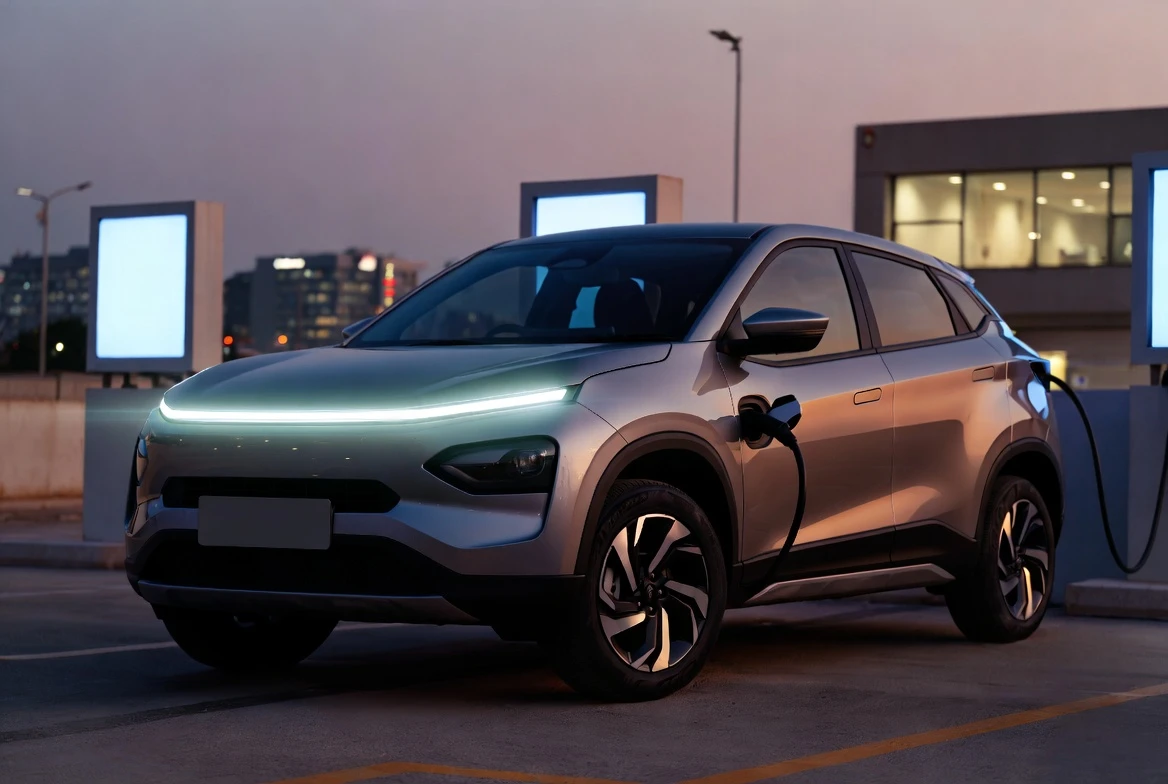
Outside, the Sierra EV wears an all-LED lighting package with a connected LED light bar at both ends and a blanked-off grille typical of battery-electric SUVs. Flush-fitting door handles, 18-inch diamond-cut alloy wheels, Tata EV badging on the front doors and an integrated spoiler round out the exterior updates. Sierra EV lettering sits on the tailgate below a shark-fin antenna. Revised front and rear skid plates give the lower body a more rugged appearance than the standard ICE Sierra.
Inside, the dashboard runs three screens: a digital instrument cluster, a central infotainment display and a third screen for the front passenger. Tata has fitted a four-spoke steering wheel with an illuminated Tata EV logo, a panoramic sunroof, and front seats with electric adjustment and ventilation. Rear passengers get rear AC vents, rear sunblinds and boss mode for the front passenger seat.
The audio system is a JBL-branded setup with Dolby Atmos, with wireless Apple CarPlay and Android Auto as standard. Safety equipment runs to six airbags, all-wheel disc brakes, ABS with EBD, electronic stability programme, a tyre pressure monitoring system, an acoustic vehicle alert system, and a Level 2 ADAS package.
Where It Sits Against the Creta Electric
The Sierra EV enters a segment now anchored by the Hyundai Creta Electric, which the official Creta Electric variant and range page lists from Rs. 18.02 lakh for the Executive variant with the smaller 42kWh battery. Creta Electric trims climb through Smart, Smart (O), Premium and Excellence, with the higher variants pairing the larger 51.4kWh battery. Hyundai claims 420km of range on the 42kWh Creta Electric and 510km on the 51.4kWh version. The Sierra EV’s entry Pure lists at Rs. 18.79 lakh with a 63kWh pack and a claimed 565km of range, against 420km for the Hyundai’s entry trim. Tata’s quoted range on the 75kWh pack runs to 665km, above the Hyundai’s 510km ceiling.
| Specification | Tata Sierra EV | Hyundai Creta Electric |
|---|---|---|
| Starting price (ex-showroom) | Rs. 18.79 lakh | Rs. 18.02 lakh |
| Battery pack options | 63 kWh, 75 kWh | 42 kWh, 51.4 kWh |
| Claimed range | 565 km to 665 km (MIDC) | 420 km to 510 km |
| Drivetrain layout | Rear-wheel drive; AWD optional | Front-wheel drive |
| Fast-charging claim | 250 km+ in 15 minutes (express) | 58 min (10% to 80%) |
The two cars target different buying math. Creta Electric’s lower entry price attracts buyers comparing EVs against mid-size petrol SUVs, while Sierra EV’s larger battery as standard positions it as the longer-distance option in the segment. Tata’s claimed 665km range on the 75kWh pack also tops the Creta Electric’s quoted 510km ceiling, on paper at least. The Creta Electric counters with an 11kW AC home charger that fills the 42kWh battery from 10% to 100% in four hours, against Sierra EV’s 7.2kW wall-box accessory.
The EV Lead Tata Is Defending
The Sierra EV launches with Tata Motors holding the dominant share of India’s electric passenger vehicle market. The company crossed 250,000 cumulative EV sales in late 2025, with a 66% market share in the EV passenger vehicle segment, according to the company’s announcement at the time. Nexon.ev became the first Indian EV to cross 100,000 cumulative sales in the same period.
Tata Motors posted 10,517 EV units in May 2026, a new monthly high and an 85% year-on-year rise. The company delivered 59,790 passenger vehicles in May 2026, up 42% from 42,040 units a year earlier, with VAHAN registrations up over 50% year-on-year, according to the company’s May 2026 passenger vehicle sales release.
Crossing 250,000 EV sales reflects how electric mobility is fast becoming part of everyday Indian life. Our customers are driving more, travelling farther, and increasingly trusting EVs as their only cars.
Shailesh Chandra, MD & CEO of Tata Motors Passenger Vehicles Ltd., said in a December 2025 statement on the EV milestone, as reported by Tata’s December 2025 EV milestone statement. The release also noted Tata’s “Firmly No. 2” position in the overall passenger vehicle market based on VAHAN data. Sierra EV joins the Curvv.ev and the production-bound Avinya as the next pillar of Tata’s electric SUV push, with a new Punch.ev also slated for 2026. Tata is also working to localise battery cells through the Agratas gigafactory in Sanand, Gujarat, with current vehicles already carrying 50% locally manufactured content and the brand’s EV network already running to over 2 lakh charging points.
Bookings Open, Deliveries Begin 15 July
Tata Motors has opened Sierra EV bookings immediately, with deliveries scheduled to begin on 15 July across all five variants. Buyers can configure the car through Tata’s passenger vehicle website and at authorised EV dealerships. The introductory pricing applies for the launch period.
Every Sierra EV ships without a charger by default, and the 7.2kW AC fast charger is a Rs. 49,000 accessory. Buyers wanting the QWD all-wheel-drive system pay a Rs. 1.20 lakh premium over the Rs. 24.79 lakh Empowered A 75kWh RWD price. Tata has not yet disclosed how the QWD version’s range or performance figures differ from the rear-drive 75kWh version. For related reading on Tata’s broader passenger vehicle roadmap, see this publication’s report on Tata Motors’ filed FY31 roadmap.
Frequently Asked Questions
What is the starting price of the Tata Sierra EV?
Tata Motors has priced the Sierra EV from Rs. 18.79 lakh, ex-showroom Mumbai, for the Pure variant with the 63kWh battery. The line-up runs to Rs. 24.79 lakh for the Empowered A 75kWh rear-drive variant, before the Rs. 1.20 lakh QWD premium.
What is the claimed range of the Tata Sierra EV?
Tata claims 665km of range on the MIDC cycle for the 75kWh pack and 565km for the 63kWh pack. Real-world range typically lands below MIDC claims, and independent test results will give a clearer picture once deliveries begin in July.
When do Tata Sierra EV deliveries start?
Deliveries are scheduled to begin on 15 July 2026. Bookings are open immediately through Tata’s website and authorised EV dealerships, with the introductory pricing running for the launch period.
How does the Tata Sierra EV compare to the Hyundai Creta Electric?
The Creta Electric starts at Rs. 18.02 lakh with a 42kWh battery and a claimed 420km range. Sierra EV opens at Rs. 18.79 lakh with a 63kWh battery and a claimed 565km range, and reaches 75kWh and 665km at higher trims. The Hyundai tops out below 510km of claimed range, against 665km for the top Tata.