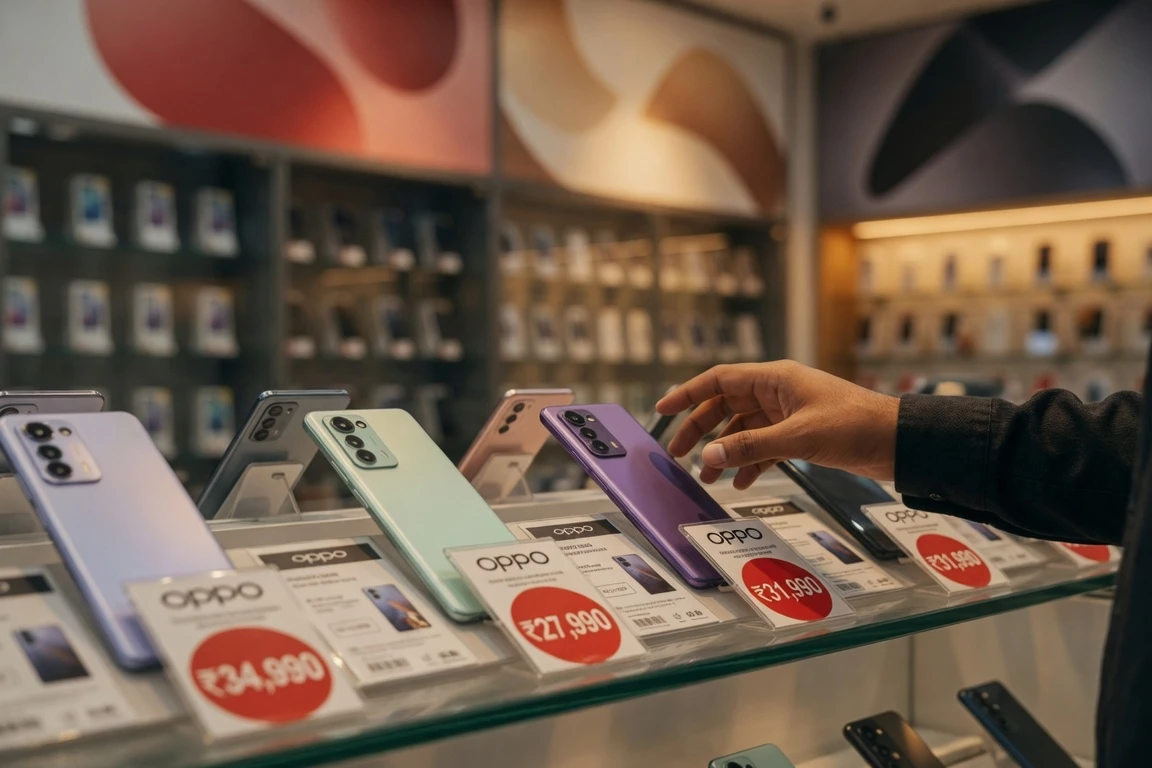
OPPO has raised prices on eight smartphone variants in India, the Chinese phone maker’s third pricing revision in less than a month, as AI-driven memory costs from suppliers continue to bite across the industry. The new prices took effect on June 22, 2026, and apply to models in the A6 5G, A6 Pro 5G and F33 5G lineups, according to a price revision notice sent to retailers. Hikes range from ₹2,000 to ₹3,000, with percentage increases between 5.26% and 9.38%.
The revision lands on a market already contracting. Counterpoint Research recorded a 3% year-on-year drop in India’s smartphone shipments for the January-March quarter of 2026, the weakest quarter in six years, and forecasts a double-digit decline in Q2, with memory prices projected to rise 80%-85% sequentially.
Eight Variants, New Prices
Most variants went up by ₹2,000, with the F33 5G starting variant jumping by ₹3,000. The 4GB + 128GB version of the A6 5G is the second-steepest riser, climbing 9.09% from ₹21,999 to ₹23,999. The full set of revised prices, as listed in the retailer notice:
| Model | Variant | Old Price | New Price | Increase |
|---|---|---|---|---|
| OPPO A6 5G | 4GB + 128GB | ₹21,999 | ₹23,999 | ₹2,000 |
| OPPO A6 5G | 6GB + 128GB | ₹23,999 | ₹25,999 | ₹2,000 |
| OPPO A6 5G | 6GB + 256GB | ₹25,999 | ₹27,999 | ₹2,000 |
| OPPO A6 Pro 5G | 8GB + 128GB | ₹26,999 | ₹28,999 | ₹2,000 |
| OPPO A6 Pro 5G | 8GB + 256GB | ₹29,999 | ₹31,999 | ₹2,000 |
| OPPO F33 5G | 6GB + 128GB | ₹31,999 | ₹34,999 | ₹3,000 |
| OPPO F33 5G | 8GB + 128GB | ₹34,999 | ₹36,999 | ₹2,000 |
| OPPO F33 5G | 8GB + 256GB | ₹37,999 | ₹39,999 | ₹2,000 |
The F33 5G (6GB + 128GB) is the steepest rise in the latest batch, a 9.38% increase from ₹31,999 to ₹34,999. The F33 5G (8GB + 256GB) saw the smallest move in the new list, a 5.26% bump from ₹37,999 to ₹39,999.
The F33 5G was launched in India earlier this year as a mid-range selfie-focused phone, with the lineup’s F33 series launch and configurations showing the original ₹31,999 to ₹40,999 range. OPPO has not officially disclosed the reason for the latest revision. Industry factors such as memory chip costs, logistics, currency fluctuations and manufacturing expenses are most likely behind the move, per My Mobile India.
Three Hikes in Less Than a Month
The June 22 revision is OPPO’s third such move in India since late May, all of them linked to the same supply chain pressure. The hikes have come on OPPO’s mid-range A-series, the budget K-series and the flagship Find X9 lineup in succession. The Find X9 series, Find X9 series launch and configurations unveiled in November 2025 with a starting price of ₹74,999, had its flagship Find X9 variant priced up by ₹10,000 on May 26. The earlier rounds, in order:
- May 26, 2026: OPPO’s flagship Find X9 series saw both storage variants become costlier by ₹10,000. The 12GB + 256GB model moved from ₹74,999 to ₹84,999, a 13.33% increase, while the 16GB + 512GB model rose from ₹84,999 to ₹94,999, an 11.76% increase.
- June 17, 2026: The K14x 5G lineup, OPPO’s budget battery-focused 5G phone, saw all three storage variants rise by ₹1,000. The 4GB + 64GB base model crossed the ₹15,000 mark, moving from ₹14,999 to ₹15,999.
- June 22, 2026: The A6 5G, A6 Pro 5G and F33 5G lineups moved together, with eight variants getting a price bump of ₹2,000 to ₹3,000.
OPPO is not alone. Multiple smartphone brands have raised prices since the start of 2026, as the cost of memory components has climbed with the buildout of AI infrastructure. The K14x 5G (4GB+64GB) had a 6.67% bump, the steepest in that revision, while the 6GB+128GB variant recorded the lowest hike at 5.26%, per Outlook Business.
The K14x 5G revision came five days before the latest A-series and F33 round. OPPO’s flagship lineup took the biggest percentage hit of the three, with the Find X9 (12GB+256GB) moving 13.33% from ₹74,999 to ₹84,999, and the 16GB+512GB model moving 11.76% from ₹84,999 to ₹94,999. The May 26 increase marked the first of the three rounds, setting a pattern that the June 17 and June 22 revisions would follow. Each round, in turn, was tied to the same supply chain pressure around memory components.
The Memory Squeeze Behind the Move
OPPO pinned the latest revision on rising memory component costs from supply chain partners in India, a pressure the company attributes to the recent surge in demand linked to artificial intelligence technologies. The story is broader than any single brand. The All India Mobile Retailers Association (AIMRA) frames the issue more broadly, with Kailash Lakhyani, Founder Chairman of the group, naming Bill of Materials (BOM) costs, chipset shortages, fluctuating dollar rates and broader inflationary pressures as the drivers behind repeated hikes, per Outlook Business.
Counterpoint Research, tracking the global memory market, expects NAND and DRAM prices to keep rising through 2026, a forecast the firm says is already forcing OEMs to recalibrate margins and product strategies. Nearly one-third of model launches were advanced into Q1 2026 to offset rising BOM inflation. The pressure, in other words, was visible at the planning stage long before June 22.
A Market Already in Decline
India’s smartphone market entered this latest round of price hikes already contracting. Counterpoint’s Monthly India Smartphone Tracker recorded a 3% year-on-year decline in shipments for the January-March quarter of 2026, the weakest quarter in the last six years. The research firm tied the slide to supply-side cost pressures, OEM-led price hikes and weak consumer demand, a mix that weighed on retail conversions across channels even as launch activity picked up.
The market is facing a clear affordability squeeze, driven by sharp memory-led cost inflation and currency pressures that have forced OEMs to raise prices across key models. With average hikes exceeding INR 1,500, the sub-INR 15,000 segment has been hit the hardest, given its high price sensitivity.
Prachir Singh is a Senior Analyst at Counterpoint Research, and the firm’s Q1 2026 report carries the full quote. The decline reflects more than a quarter of weak demand – per the Q1 2026 India smartphone market data and analysis, over 80 models saw an average 15% price hike in Q1 2026, with a further 15%-20% rise expected in Q2 as memory prices are projected to climb 80%-85% sequentially. The price hike count keeps building: a 4x memory price rise over the past three quarters has now hit a market that was already shrinking.
Counterpoint’s Q1 numbers also captured the brand reshuffling. vivo (excluding iQOO) led the market with a 21% share, Samsung held second place, and OPPO (excluding OnePlus) retained its third position with a 14% share. OPPO’s 8% YoY growth made it the fastest-growing brand among the top five, even as the broader market shrank.
The Retailer Warning
AIMRA has warned that the current cycle of smartphone price hikes is unlikely to end anytime soon. The association’s founder chairman has a direct message for buyers, after retailers and distributors flagged concern over the impact of repeated hikes on sales volumes in stores.
Consumers should not wait to make their purchases because prices are expected to continue increasing.
Kailash Lakhyani is the Founder Chairman of the All India Mobile Retailers Association (AIMRA), and the group represents mobile retailers across the country. Counterpoint’s near-term outlook tracks the same direction. Research Director Tarun Pathak said Q2 2026 is likely to see a double-digit decline, with the full year projected to fall 10% YoY, as memory has already increased 4x over the past three quarters. The pass-through to consumers, in other words, is still incomplete.
Recent market information cited by Outlook Business suggests Samsung smartphones priced below ₹25,000 may see the next round of increases. Recent reports have also pointed to possible pricing revisions by Apple. The trend that started in late 2025 is now reaching the price tags of every major brand’s sub-flagship line.
Who Pays the Heaviest Cost?
The pressure is not landing evenly. Counterpoint’s Prachir Singh said the sub-INR 15,000 segment has been hit the hardest, given its high price sensitivity, and that the affordability squeeze is forcing households to prioritise essentials over discretionary purchases. Rising energy costs amid ongoing geopolitical tensions in the Middle East are also straining household budgets, per Counterpoint’s Q1 2026 report. The result is longer replacement cycles, with consumers putting off upgrades. A snapshot of the pressure:
- 3% YoY decline in India smartphone shipments, Q1 2026
- Six-year low for quarterly shipments, per Counterpoint
- 80+ smartphone models saw an average 15% price hike in Q1 2026
- 15-20% further price rise expected across the market in Q2 2026
For OPPO, the timing is awkward. The brand held third place in India’s smartphone market in Q1 2026 with a 14% share, and grew 8% YoY, the fastest growth among the top five, per Counterpoint. That growth came even as the broader market shrank, and before the second and third rounds of price hikes began. The A6 5G, A6 Pro 5G and F33 5G are part of the lineup that drove OPPO’s Q1 budget and mid-range momentum, alongside the K-series. The June 22 revision will test how much of that growth the brand can hold onto.