Invasive Argentine black and white tegus are drawing fresh attention in southeast Georgia, where state wildlife biologists say reports of the four-foot lizard have climbed again this year. The animals, native to South America, eat the eggs of protected species including American alligators and gopher tortoises, and biologists are watching for the exotic parasites other invasive reptiles have carried into native populations.
The Georgia Department of Natural Resources has logged 56 reports across the state over the last few years, with the highest counts in Tattnall and Toombs counties in the southeast. The agency is now asking landowners to remove any they find on private property and report the rest, and it lists the species as a wild animal that cannot be imported or bred in the state.
The Four-Foot Lizard Eating Georgia’s Wildlife
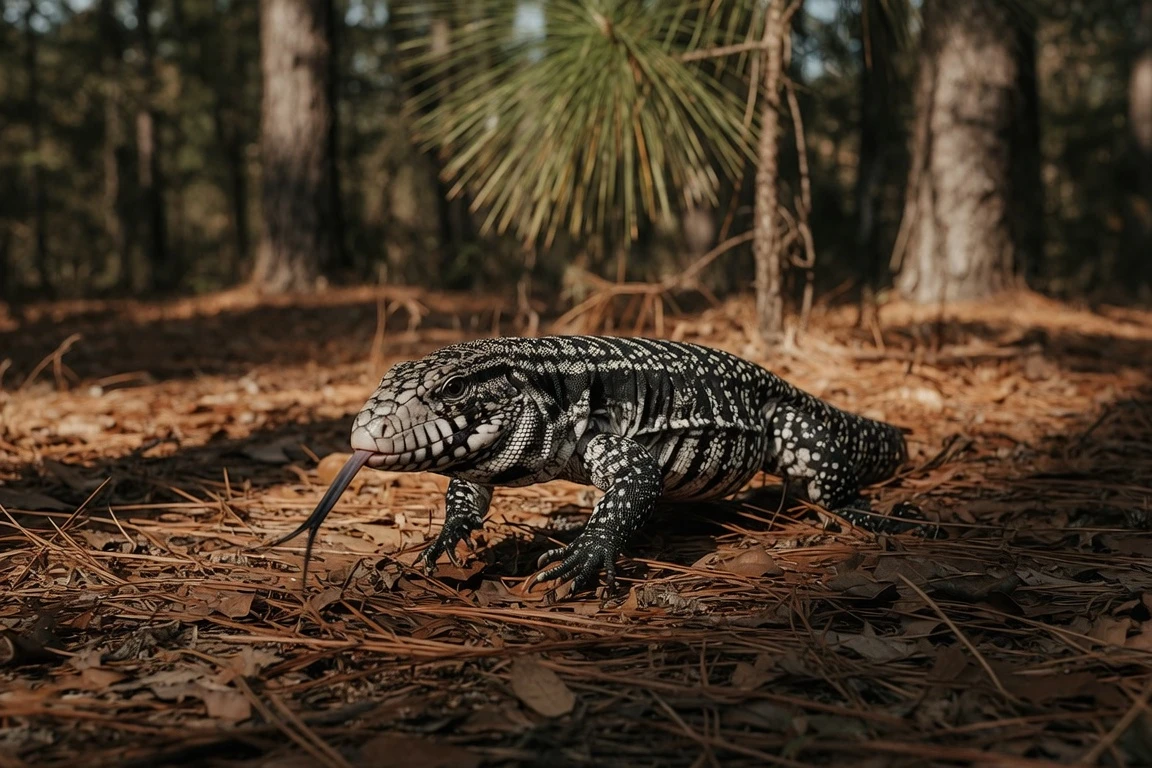
Argentine black and white tegus are the largest species in the tegu family, growing up to four feet long and weighing 10 pounds or more. They have black to dark gray skin crossed by white speckled bands, and hatchlings are born with bright green heads that fade after about a month.
- Up to 4 feet long
- 10 pounds or more
- 20-year lifespan in the wild
- 35 eggs per year
- 60-day egg incubation
- Hatching expected in June and July in Georgia
The species is native to Brazil, Paraguay, Uruguay, and Argentina, where it occupies mixed grassland and woodland edges, and the same habitat profile applies in Georgia. The state wildlife agency’s full tegu profile notes females can lay about 35 eggs a year, with hatching in Georgia expected in June and July. The lizards are fast on land and strong swimmers, able to stay submerged for extended periods, and they spend the cold months underground in a hibernation-like state called brumation. They emerge by day to forage, and the state profile notes they favor forest clearings, fence rows, and roadsides. They will defend themselves if threatened, lashing with their tails and using sharp teeth, claws, and strong jaws.
How a Pet-Trade Lizard Became a Georgia Problem
Tegus first showed up in southeast Georgia around 2014, and the state wildlife agency began a formal investigation in 2018 after a run of reports in eastern Toombs and western Tattnall counties. By 2025, the two counties had produced 11 confirmed reports, the most since 2018, and the same stretches of dirt roads, fence rows, and pine stands where the first reports came in are where most captures still happen. Sollenberger, the DNR senior wildlife biologist leading the response, said the agency has no firm estimate of how many tegus are in the wild because the animals are difficult to find and harder still to count. He framed the relative size of the population in plainer terms, somewhere between the number of possums and the number of coyotes in the same two counties.
DNR says it believes the population was seeded by the exotic pet trade, through released or escaped animals, and the agency’s academic partners in the effort are direct about the connection. Dr. Lance McBrayer of Georgia Southern University, a research partner on the Toombs and Tattnall response, has studied the spread and the diet of the captured animals. He framed the longer-term risk in the November 2025 tegu population status update, which the agency posted on its wildlife blog.
There can be long periods when the population simmers at a low abundance and at some point it may take off. Or it may not. Predicting the rate of increase is difficult. But when a population does increase, it does so rapidly, often growing exponentially.
McBrayer said the agency is still trying to learn which trajectory is unfolding in Toombs and Tattnall, and the uncertainty is itself part of the problem: the kind of population that looks stable for years can turn on a single good breeding season. No young tegus have been confirmed in the wild in Georgia yet, but females have been found with eggs, and Sollenberger said there is no other reasonable reason for having that many tegus in such a small area. Tegus have also been spotted in several counties across Georgia, including in South Carolina, WTOC reports, and the agency treats those reports as one-off escapees or releases rather than evidence of a third breeding population. The sign of an established population is the same one biologists use to declare a wild one: enough animals, in one place, behaving as if they live there, and that is the working assumption the agency is operating under in Toombs and Tattnall.
- 56 reports across Georgia over the last few years
- Tattnall County: 16 reports (highest)
- Toombs County: 10 reports
- Gwinnett County: 5 reports
- 11 confirmed in Toombs and Tattnall in 2025
Georgia moved to restrict ownership in 2022, when the species was added to the state’s wild animal list, banning imports and breeding. The agency then set a registration and tagging deadline of December 4, 2023: any tegu not registered and tagged with DNR by that date can no longer be kept as a pet in the state. Releasing any non-native animal into the wild without a permit is also illegal in Georgia, and the species is not protected by state wildlife laws or regulations in any form, which is what makes the public removal request legally straightforward.
What the Lizard Eats Once It Gets Here
The list of what tegus will eat in Georgia reads like a survey of the state’s most vulnerable ground-nesting species. Quail, wild turkeys, other ground-nesting birds, and chicken eggs are all on it, along with pet food and carrion in residential areas.
Two of the menu items draw the most concern from state biologists. The state’s tegu profile lists American alligators and gopher tortoises, both protected species, as targets, and DNR says the lizards will eat the eggs of alligators and the eggs and hatchlings of gopher tortoises. The burrows gopher tortoises dig are exactly the kind of shelter tegus use in cooler months, and the same burrow network that protects the tortoise can shelter a tegu waiting for the next clutch of eggs. The 2024 captures show the animals are using it.
Stomach content analysis of captured tegus from Toombs and Tattnall, run by McBrayer’s team at Georgia Southern, has turned up a similar mix. McBrayer said the contents included everything from frogs, lizards, and small snakes to muscadines, strawberries, and bugs of all stripes, with each animal carrying a mix of invertebrates, plant matter, and small vertebrates. The 2024 capture report from Toombs and Tattnall also documents a 3.5-foot tegu killed while scrambling for a gopher tortoise burrow on May 20, a smaller tegu seen nearby two days later that escaped, and a 28- to 30-inch tegu killed crossing Ga. 147 in Tattnall County on May 24.
The Parasite Risk Tegu Researchers Are Tracking
Sollenberger, who is leading the agency’s response, has flagged the parasite question as the next thing to watch. He points to Florida, where invasive Burmese pythons have been linked to a lung worm that has spread to and hurt native snake populations, and he called the outbreak a cautionary tale for what can happen when a new predator arrives without a parasite check. We have not found anything like this yet in Georgia tegus, Sollenberger said, but exotic animals often carry exotic parasites that native species have no defense against. The parallel he is drawing is the classic invasive-species pattern, and the agency’s working assumption is that the same kind of parasite-mediated collapse is the kind of thing a tegu population could eventually trigger here.
Sollenberger estimated the Florida outbreak has hit about 13 species of snakes so far, and he described the impact as a collapse in certain kinds of snakes. The state tegu profile lists the same parasite risk for tegus, and the broader worry is that a parasite moving with a new host can spread to native species with no evolved resistance. None of the parasite problems have been documented in Georgia tegus yet, but the list of what biologists are watching for is longer than the list of what they have ruled out.
The other public-health concern is older and better documented. The state’s tegu profile notes that research shows the reptiles, like most, carry salmonella, a bacterium that can cause serious gastrointestinal illness in children, older adults, and people with weakened immune systems. Salmonella is a regular finding in reptile populations, and the bacteria can pass to humans through contact with the animal or anything it has touched. The risk is one reason biologists recommend treating any wild tegu, dead or alive, as a handling hazard rather than a curiosity.
State biologists are also watching for possible crop contamination. None of this has been documented in Georgia yet, but the list of what biologists say they are looking for is longer than the list of what they have ruled out.
How Georgia Is Trying to Stop the Spread
The state’s response runs through the Wildlife Resources Division, which has been trapping and removing tegus in Toombs and Tattnall counties since 2018 in partnership with Georgia Southern and local landowners. The agency’s tegu profile lays out the public reporting system, the legal rules for removal, and the latest advice for residents of the two counties. Captured animals are humanely euthanized, and DNR uses the carcasses to track diet and reproductive status.
DNR is also asking residents in Toombs and Tattnall to keep pet food inside, fill holes that can serve as shelter, and clear brush piles and other debris that provide cover. The agency is asking anyone who sees a tegu in the wild, alive or dead, to report it. Sollenberger said that is what we need people to do if we’re going to try to control or contain this infestation. The preferred protocol is to note the location, take a photo if possible, and report through one of three channels. The reports feed the agency’s sightings map, which the agency uses to document where the species has been confirmed.
- Online at gainvasives.org/argentine-black-and-white-tegu
- Phone at (478) 994-1438
- Email at gainvasives@dnr.ga.gov
On private property, tegus can be legally trapped or killed year-round with landowner permission, using methods that comply with local ordinances, animal cruelty laws, and safety precautions. On state wildlife management areas, the animals can be taken only with firearms legal for the current hunting season on that area, and using traps on a WMA is not allowed. The agency’s guidance is the same in either case: remove them where the law allows and report the rest.
Sollenberger, who leads the response for DNR, has called wild tegus public enemy no. 1, and the agency has not set a firm population target, only a clear direction for the public side of the response. The agency’s profile is blunt: anywhere the species turns up, the goal is to keep it from reproducing and to remove every animal that is found. The 2025 status update noted that females have been found with eggs, a sign the wild population is self-sustaining. Trapping and public reports remain the agency’s two main tools, and both depend on residents in the two counties doing the reporting.
Sollenberger estimated the wild population in the two counties is somewhere between possums and coyotes in number, meaning there are likely more tegus in southeast Georgia than most residents realize, but still well below the counts that would qualify as an out-of-control infestation. The 2024 captures show the animals are still using the same stretches of dirt road and tortoise burrow they always have. McBrayer has framed the long-term risk in plainer terms: a wild tegu population that takes off does so exponentially, and the agency’s best chance to keep the curve flat is the next year of trapping.
Frequently Asked Questions
What is an Argentine black and white tegu?
The Argentine black and white tegu (Salvator merianae) is the largest of the tegu lizard species, native to Brazil, Paraguay, Uruguay, and Argentina. Adults can reach four feet in length and weigh 10 pounds or more, with black to dark gray skin crossed by white speckled bands. Hatchlings emerge at 6 to 8 inches long with bright green heads that fade after about a month.
How big do tegus get?
Adults in the wild in Argentina can reach about four feet long, and the species can weigh 10 pounds or more and live up to 20 years. Adults confirmed in Georgia have averaged slightly less than two feet so far, though the agency has documented a captured animal measuring more than 3.5 feet long. Hatchlings emerge at 6 to 8 inches and grow quickly during their first year, reaching about 12 inches by their first winter.
How did tegus arrive in Georgia?
DNR believes the population was seeded by the exotic pet trade, through animals that were released or escaped captivity. The agency added the species to Georgia’s wild animal list in 2022, banning imports and breeding, and required any tegu kept as a pet to be registered and tagged with DNR by December 4, 2023. Releasing any non-native animal into the wild without a permit is illegal in the state, and tegus not registered and tagged by the deadline can no longer be kept as pets.
Are tegus dangerous to people or pets?
DNR does not consider tegus aggressive toward people, but the agency warns that they will defend themselves if threatened, lash with their tails, and have sharp teeth, claws, and strong jaws. The state’s tegu profile notes that tegus, like most reptiles, carry salmonella, a bacterium that can cause gastrointestinal illness in people, especially children, older adults, and people with weakened immune systems. Cats and dogs are not considered to be at serious risk from adult tegus, though smaller pets could be at risk from younger animals.
Can I kill a tegu if I see one on my property?
Yes, on private property with landowner permission, using methods that comply with local ordinances, animal cruelty laws, and safety precautions. The animals can be trapped or killed year-round, and they are not protected by state wildlife laws or regulations. On state wildlife management areas, tegus can be taken only with firearms legal for the current hunting season, and traps are not allowed on WMAs.
How do I report a tegu sighting in Georgia?
DNR asks that anyone who sees a tegu in the wild, alive or dead, note the location and take a photo if possible, then report through one of three channels: the online form at gainvasives.org/argentine-black-and-white-tegu, the phone line at (478) 994-1438, or the email gainvasives@dnr.ga.gov. Reports feed the agency’s sightings map and help biologists direct trapping effort in Toombs and Tattnall counties.
Where else in the U.S. have tegus been confirmed?
Breeding populations of Argentine black and white tegus have been documented in multiple Florida counties, including Hillsborough, St. Lucie, Charlotte, and Miami-Dade. Georgia’s two known established populations are in Toombs and Tattnall counties in the southeast, and the state has also logged individual sightings in other counties, including Gwinnett in northeast Georgia, which are treated as one-off escapees or releases rather than breeding populations.