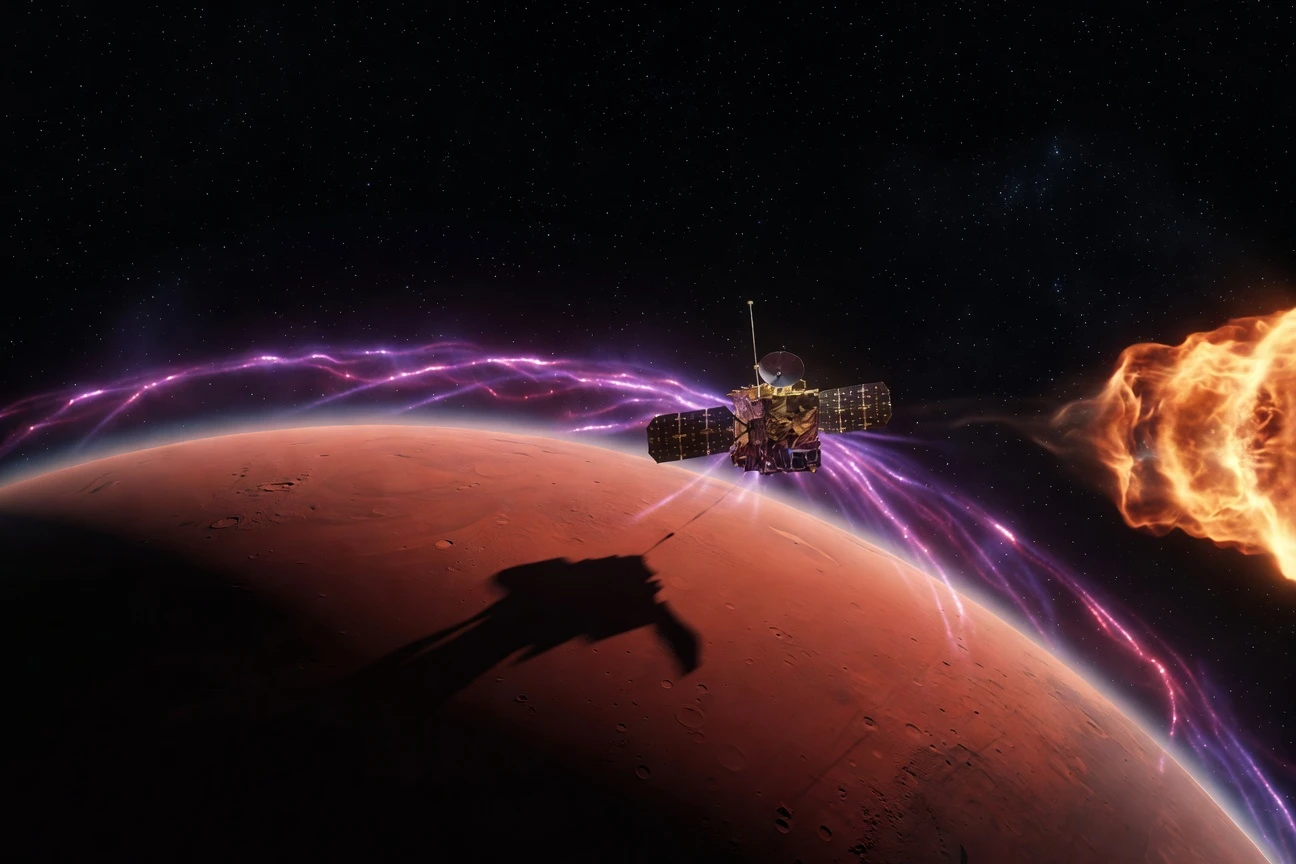
A plasma trick first described in 1976 has been measured deep inside the atmosphere of Mars, the first time the process, known as the Zwan-Wolf effect, has been seen anywhere outside a planetary magnetosphere. Researchers working with NASA’s Mars Atmosphere and Volatile Evolution orbiter, known as MAVEN, detected the signal below 200 kilometers altitude during a strong solar storm in December 2023.
The paper, published this week in Nature Communications, is the kind of first detection outside a magnetosphere that lands cleanly in a textbook. It also carries a separate beat for the engineers planning crewed Mars architectures, because the storm intensity that made the signal detectable is the class of weather any future Mars crew will need to ride out, and Mars has no global magnetic shield to soften the blow.
A Half-Century-Old Earth Effect, Spotted Where It Shouldn’t Be
In 1976, two Rice University physicists named Bryan Zwan and Richard Wolf published the mathematical model of what happens when the solar wind runs into Earth’s magnetic shield. Plasma, the soup of charged particles streaming off the Sun, gets squeezed sideways along magnetic flux tubes, like toothpaste forced from a tube, and drains into a depleted layer just outside the magnetopause. For five decades the textbook treated the effect as a fixture of planetary magnetospheres, full stop.
Mars complicates that picture, because the planet lost its global magnetic field roughly four billion years ago. What remains is a patchwork of weak crustal magnetism plus an induced magnetosphere, a thin, flexible shield that flickers into existence when the solar wind drapes itself over the planet’s ionosphere. The new study shows the Zwan-Wolf squeeze working there too, only with a different geometry, running through charged particles bound inside the upper atmosphere rather than across a clean dipole bubble.
“When investigating the data, I all of a sudden noticed some very interesting wiggles,” said Christopher Fowler, a research assistant professor at West Virginia University and the paper’s lead author, in NASA’s announcement. The wiggles were swings in the orbiter’s magnetometer readings that did not fit any standard explanation for ionospheric variability. After ruling out alternatives, the team converged on the only mechanism that produced a consistent fit, the same one Zwan and Wolf had described half a century earlier at Earth.
How MAVEN Caught the Squeeze
The detection came out of a single event, a strong solar storm that hit Mars in December 2023. During quieter conditions the squeeze probably runs continuously, but at intensities the spacecraft’s instruments cannot resolve. The December storm cranked the amplitude up high enough to leave a clean fingerprint, which is what Fowler’s team set out to analyze.
MAVEN carries a suite of plasma and magnetic-field sensors purpose-built to study how Mars’s upper atmosphere is being stripped away by the Sun. The orbiter swings on a 4.5-hour ellipse that dips into the ionosphere at periapsis, which gives it a rare ability to sample charged-particle behavior at altitudes most spacecraft do not survive. Fowler’s team pulled magnetometer, ion mass spectrometer, and electron spectrometer data from the same orbits and aligned them in time. What emerged was a consistent pattern, magnetic field strength rising while plasma density fell along the same flux tubes, exactly the inverse correlation predicted at Earth.
The team also ruled out other candidate mechanisms, including wave heating, density gradients tied to neutral winds, and instrument noise, before settling on the Zwan-Wolf process as the only one that matched every signature. The numbers behind the find:
- Below 200 kilometers: altitude where the effect was measured, deep inside the Martian ionosphere
- December 2023: the solar storm that pushed the signal above detection threshold
- 1976: original publication year for the Zwan-Wolf model at Earth
- About 13 years: time the orbiter has been collecting data at Mars, building the archive that made this find possible
The catch is that this is a single-event detection. Repeating the analysis across other storm intervals will tell scientists whether the effect scales smoothly with solar wind pressure or behaves differently at the extremes.
Where Earth’s Shield Ends, Mars Improvises
Earth and Mars are not the only unmagnetized worlds in this conversation. Venus and Saturn’s largest moon Titan are also wrapped in induced magnetospheres, the product of external plasma flow (solar wind for Venus, Saturn’s magnetospheric plasma for Titan) interacting directly with thick, ionized upper atmospheres. The Mars detection is the strongest reason yet to look for the same plasma squeeze in those environments.
The Earth Baseline
Earth’s global dipole carves a clean cavity in the solar wind. Plasma piles up at the dayside magnetopause, gets squeezed sideways along flux tubes, and creates the depletion layer Zwan and Wolf described. Decades of in-situ measurements from missions like Cluster and THEMIS turned the effect into a textbook constant.
The Martian Variant
Mars handles things differently. With no global field, the solar wind reaches the upper atmosphere directly, and the ionosphere itself acts as the obstacle. Charged particles inside the ionosphere can still be pushed along draped magnetic field lines, lines that the solar wind essentially paints onto the planet, and that produces the same depletion signature, just embedded in atmospheric layers rather than in a vacuum cavity.
What That Means for Venus and Titan
Both bodies share the Martian setup, no internal dynamo, plenty of charged atmosphere. NASA’s DAVINCI Venus mission, scheduled to launch in 2031, will carry plasma sensors capable of looking for the same signal during its dive. The European Space Agency’s EnVision Venus orbiter aims for arrival later that decade with an instrument suite that would also be useful.
| Body | Magnetic field | Atmosphere | Zwan-Wolf detection |
|---|---|---|---|
| Earth | Global dipole | Nitrogen and oxygen, dense | Confirmed since the 1980s |
| Mars | Induced plus crustal patches | Thin, CO2-dominated | First detection in the new study |
| Venus | Induced only | Thick, CO2-dominated | Not yet observed |
| Titan | Embedded in Saturn’s magnetosphere | Thick, nitrogen-dominated | Not yet observed |
If the same squeeze runs at three of these four worlds, plasma physics built around magnetospheres alone has been missing a whole class of phenomenon, and comparative planetology has new questions to test.
The Number That Should Worry Mission Planners
In May 2024, the largest solar energetic particle (SEP, a burst of high-speed charged particles thrown out by flares and coronal mass ejections) event the orbiter had ever recorded slammed into Mars. The same storm registered at the surface through Curiosity’s Radiation Assessment Detector (RAD, a small radiation-tracking instrument bolted to the rover), which logged a dose of 8,100 micrograys in that single event, equivalent to roughly 30 chest X-rays, and the largest spike RAD had seen in twelve years on the ground.
How the Geometry Helps Particles Through
The Zwan-Wolf detection adds a complication to the radiation picture. When solar weather is strong enough to drive the effect deep inside the ionosphere, the magnetic geometry that normally helps deflect incoming particles is itself being deformed. Particles that might have been turned aside under quiet conditions can find clearer paths down toward the surface, and the same storms that strip atmosphere are the ones that compress the shielding.
Why the Solar Cycle Timing Matters
Solar maximum, the peak of the Sun’s eleven-year activity cycle, is happening now. NASA’s Artemis II crew, commanded by Reid Wiseman with pilot Victor Glover, launched on April 1 of this year for a 10-day lunar flyby through the same elevated radiation environment. Crewed Mars architectures still under study assume astronauts will spend roughly six months in transit each way and stay on the surface for months or longer. Engineers designing those vehicles need to plan against this radiation envelope:
- An induced magnetosphere that can lose coherence during major storms
- Surface radiation doses that can spike to thirty chest X-rays in hours
- Plasma physics in the ionosphere that locally amplifies or redirects particle flow
- No global magnetic field to soften any of the above
Other Unmagnetized Worlds Are Listening
The Mars result tells comparative planetologists they have been undercounting where the Zwan-Wolf squeeze operates. Any rocky body with a thick enough ionosphere and no internal dynamo becomes a candidate.
That short list includes Venus, sampled briefly by ESA’s Venus Express and now awaited by two new missions, and Saturn’s moon Titan, where Cassini’s plasma instruments saw enough exotic interactions to suggest the same effect could be present. The Dragonfly rotorcraft mission to Titan, due to launch in July 2028 and reach Saturn’s moon in 2034, will not measure plasma directly, but its arrival will likely reopen the case for orbital plasma science there.
Knowing how space weather interacts with Mars is essential. The MAVEN team continues making discoveries with our datasets and finding these links between our host star and the Red Planet.
That comment came from Shannon Curry, the mission’s principal investigator and a research scientist at the Laboratory for Atmospheric and Space Physics at the University of Colorado Boulder. Her team has been working through the orbiter’s archive for a decade, and the Zwan-Wolf paper is one of several recent reanalyses that found signal where earlier passes saw noise.
The broader point is that magnetic shielding is not binary. A planet either has a strong global field or it does not, and the in-between cases (induced fields, draped flux tubes, crustal magnetic anomalies) host plasma physics that matters for both atmospheric evolution and for any spacecraft passing through.
MAVEN’s Own Silence
The orbiter that delivered this discovery has not phoned home in five months. NASA last received a signal from MAVEN on December 6, 2025, when the spacecraft slipped behind Mars during a routine occultation. When it should have re-emerged on the far side, it did not check in, and fragments of recovered telemetry suggested the spacecraft was tumbling, with a trajectory that may have shifted. A NASA anomaly review board was convened in mid-February to evaluate the recovery effort and the spacecraft’s probable state, and that review is still open.
- November 2013, the orbiter launches from Cape Canaveral
- September 2014, the spacecraft enters Mars orbit
- December 2023, the data later analyzed as the Zwan-Wolf signature is collected
- May 2024, the orbiter records the largest solar energetic particle event of its mission
- December 6, 2025, last signal received
- February 2026, NASA convenes the anomaly review board
- May 18, 2026, the Zwan-Wolf paper publishes in Nature Communications
The paper Fowler led, drawn from data collected years before the silence, is a reminder that the archive a long-lived orbiter leaves behind keeps doing science long after the spacecraft itself goes quiet. The orbiter is still up there, presumed to be tumbling above a planet whose magnetic life it just helped rewrite, and the data MAVEN sent home is the part that matters now.