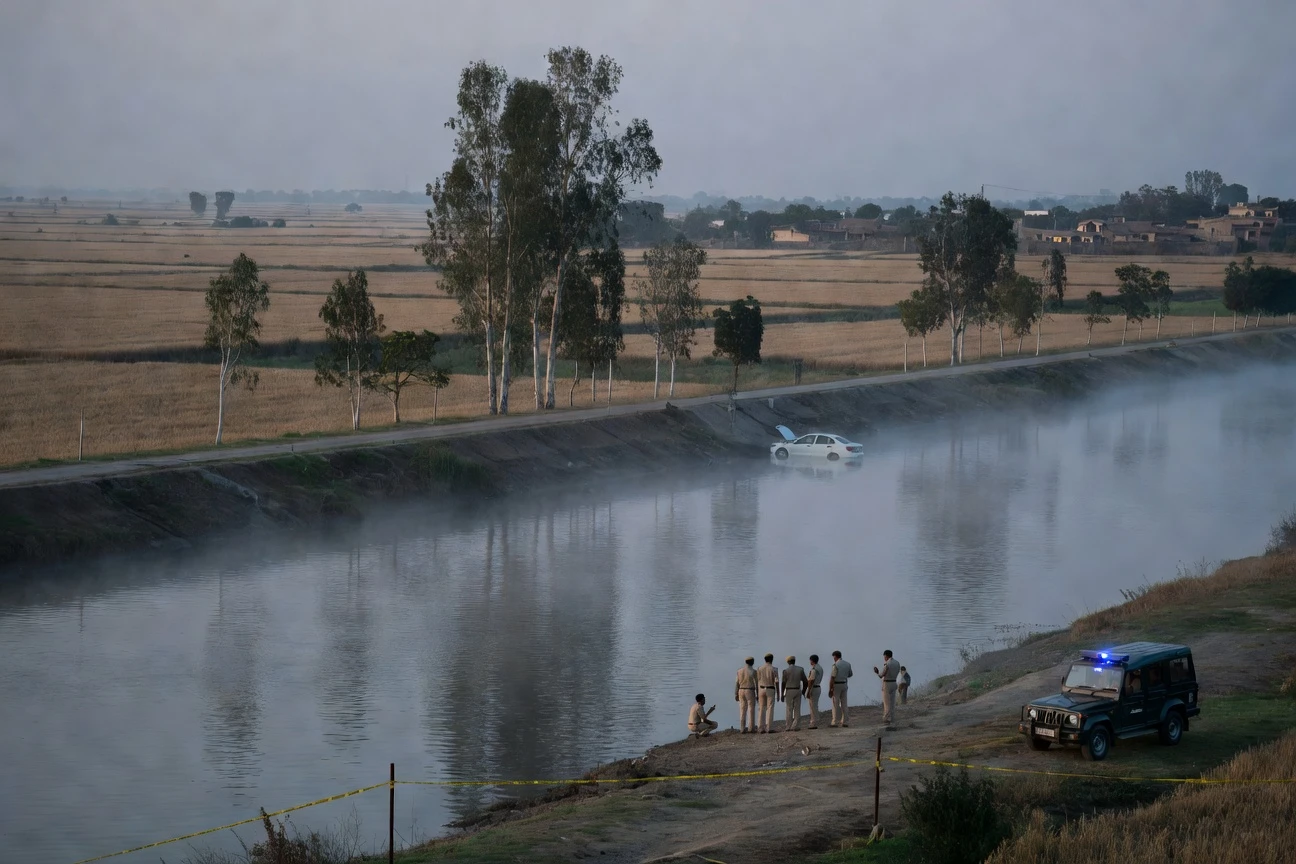
The body of Punjabi singer Yashinder Kaur, known professionally as Inder Kaur, was pulled from the Neelon Canal near Ludhiana’s Kuba village on Tuesday, six days after she was abducted at gunpoint outside her home in Mundian Kalan. Her white Ford Figo, recovered roughly a kilometre from the spot, carried blood stains that investigators say place the killing inside the vehicle.
The man Jamalpur police want for the murder is a Canada-based former boyfriend named Sukhwinder Singh. He flew into India through Kathmandu on April 29 and flew back out the same way on May 13, the night the 29-year-old singer disappeared. Two of his alleged accomplices are in custody. The principal accused now sits inside another country’s extradition queue.
Six Days Between GTB Nagar and a Body in the Water
On the night of May 13, Inder Kaur left her parents’ house around 8:30 PM, telling her family she was driving to the market for groceries. She did not come back. The family rang her phone within the hour; it was switched off. By the next morning, relatives had retraced her route and pieced together what neighbours and street vendors had seen at GTB Nagar in Mundian Kalan: armed men, a forced exit from the Ford Figo, a second vehicle waiting.
Her brother Jyotinder Singh walked into Jamalpur police station with three names. The First Information Report (FIR, the document that opens a criminal case in India) listed Sukhwinder Singh alias Sukha, a Moga native long settled in Canada; his father Pritam Singh; and Karamjeet Singh of village Bhaloor in Moga. The family told investigators that Sukhwinder had been pressing the singer to marry him for months. She had refused.
What investigators recovered six days later told the rest. The car came out of the Neelon Canal near Rampur village with its interior streaked in blood. The body surfaced a short distance away, the kind of distance that suggests someone weighed the boot of a sedan against the current and chose the current.
The initial probe suggests that the woman was murdered in the car and later her body was dumped into the canal.
That sequence, narrated by Sub-Inspector Dalvir Singh, Station House Officer at Jamalpur, is the working theory the post-mortem at Samrala Civil Hospital is now being asked to confirm. A senior officer with the Ludhiana commissionerate has separately said the suspect shot the singer before disposing of car and body in the canal.
The Singer Behind the FIR
Inder Kaur was 29. She built her early audience on YouTube from 2018 with vocal tracks aimed at Punjab’s roadside-stereo circuit, the kind of music that travels on tractor speakers in Mansa and on DJ booths in Brampton with equal ease. Her singles included Chitti Jatti, Sohna Lagda, Rich Standard and Jatt Mind. A 2017 collaboration with Parmish Verma on Desi Sirre De gave her one of her bigger spikes in views.
Her Instagram account, with more than 125,000 followers, mixed studio clips with reels from a small boutique she had been running in Ludhiana. In the past two years she had moved much of her working time away from music and toward retail and bridal make-up, a common pivot for mid-tier Punjabi vocalists whose royalty cheques never catch up to the cost of a release schedule. Collaborators describe a career that was steady rather than vertical.
Two of her brothers and both her parents now live abroad. Jyotinder was the family member in Ludhiana, the one who tried her phone first that night and the one who walked into the police station the next morning with the names.
The Accused and a Travel Pattern Through Kathmandu
By the family’s account given to investigators, the relationship between Inder Kaur and the man now sought for her killing began on Instagram and lasted long enough to acquire the heat of a marriage demand. It ended when she discovered that he was already married with children at his Canadian address.
What he did next is the most operationally telling fact in the case. He did not fly Toronto to Delhi or Vancouver to Amritsar, routes that would have put him on Indian immigration’s watchlists before his bag hit the carousel. He flew Toronto to Kathmandu, then crossed into India by road on April 29, the open Indo-Nepal land border being a route well documented in central agency briefings on fugitives entering the country to settle private business.
He stayed about two weeks. He left through the same crossing on the night of the abduction, then boarded a departure that put him back inside Canadian jurisdiction before the Jamalpur FIR was even drafted. The choreography is not novel. It has, by now, become a recognised template in Punjab’s organised-crime files, where Khalistan-linked fugitives, gang operators and personal-vendetta suspects have all used the Kathmandu shuttle to enter and exit India without triggering passport flags at Delhi or Amritsar airports.
The Punjab Director General of Police’s office has, in earlier cases, asked the Ministry of Home Affairs to push Nepal-border biometric integration onto the federal agenda. The asks have moved more slowly than the people they were designed to catch. For families in Mundian Kalan this week, that gap is the difference between a suspect facing a Punjabi magistrate and a suspect taking calls from a suburb outside Brampton.
A Punjab Pattern That Began With Jassi Sidhu
Twenty-six years before a body surfaced in the canal off Kuba, another body surfaced in an irrigation canal forty-five kilometres outside Ludhiana, near Kaonke Khosa. That body belonged to Jaswinder Kaur Sidhu, a 25-year-old Indo-Canadian beautician whose mother and uncle, both Canadian citizens, were later found to have ordered her killing for marrying outside the clan. The case set a template for a kind of Punjab crime that has recurred in waves since: violence rooted in a family or romantic dispute, executed inside Punjab, plotted or carried out by someone who lives in Canada.
The 2000 Killing That Set the Template
In Jassi’s case, the planners stayed in British Columbia while contracted killers carried out the work in Punjab. The investigation, the extradition fight, and the eventual transfer of the two principal accused from Canadian to Indian custody took almost two decades. The Supreme Court of Canada cleared the extradition on September 8, 2017. Surjit Singh Badesha and Malkit Kaur Sidhu were flown to Delhi on January 24, 2019. As of mid-2025, both remained on bail and the trial in a Punjab court was still in progress.
What Looks Different This Time
The Inder Kaur file differs in one important way: the man Jamalpur wants is not someone who placed a phone call from Vancouver. He is, on the police’s reading, someone who flew into India to do the killing himself and then went home. That changes the contents of any extradition request, and it changes what a Canadian judge would have to weigh.
| Factor | Inder Kaur (2026) | Jassi Sidhu (2000) |
|---|---|---|
| Victim age | 29 | 25 |
| Where the body was found | Canal near Ludhiana | Irrigation canal near Kaonke Khosa |
| Canada link of main accused | Lives in Canada; entered India via Nepal to allegedly carry out the killing | Canadian citizens who allegedly ordered the killing from British Columbia |
| Stated motive | Refused marriage to an already-married man | Family opposed her marriage on clan grounds |
| Suspects in Canada | One principal accused | Two principal accused |
| Extradition status | FIR-stage; no formal request yet | Extradited January 2019, seventeen years after the crime |
The 26-Request Wall Between Delhi and Ottawa
An extradition request, if Jamalpur pushes the case up to the Ministry of External Affairs (MEA) and the MEA forwards it to Ottawa, will land on a pile that has barely moved in a decade. India has 26 extradition requests pending with Canada, MEA spokesperson Randhir Jaiswal said in October 2024, with Canadian authorities having resolved only five. The named individuals in those filings include terror suspects with cases far older than the 2024 statement itself.
“Over the last decade or more, there have also been several requests for the provisional arrest of criminals, all of which remain unaddressed,” Jaiswal told reporters that month, calling the situation a serious concern. Canadian officials have responded that requests they receive go through legal review and that the bar for extradition to a third country is a function of Canadian law, not Indian frustration. The MEA’s own extradition reference page sets out the procedure and the standard of evidence India must meet.
Bilateral weather has not helped. Relations between Delhi and Ottawa have been at their lowest point in years since the 2023 allegations linking Indian government agents to the killing of Hardeep Singh Nijjar in British Columbia. Six diplomats were expelled by each side in October 2024. Extradition requests do not pause when relations sour, but they slow, and they slow at the file-by-file desk-officer level where most of the actual work happens.
Even in cases where Canadian benches eventually agree to send a suspect to India, the timeline is measured in years. The Sidhu file took seventeen. A 2018 conspiracy-to-murder case is still moving through Canadian appeal courts. Jamalpur’s prosecutors, whatever paperwork they draft this month, are filing into that headwind.
Where the Jamalpur File Sits Now
Two arrests have been made. The third name, the one the family put first on the FIR, is the one Punjab Police cannot reach without a passport stamp and a foreign court order.
- Pritam Singh, father of the main accused, arrested in Moga and held in judicial custody.
- Karamjeet Singh, the alleged accomplice from village Bhaloor, arrested and remanded alongside.
- Sukhwinder Singh alias Sukha, the principal accused, believed to be back inside Canada after departing through Kathmandu on the night of the abduction.
The post-mortem from Samrala Civil Hospital will fix cause of death and shape the sections that get formally added to the FIR over the coming days. Forensic teams have lifted samples from the Ford Figo’s interior and from the canal-bank recovery site. Punjab Police’s organised-crime cell has been informally looped in for the cross-border angle. The state’s long-running grievance with Canadian inaction on fugitive transfers is the diplomatic context the file will inherit if it reaches South Block.
Punjab’s conviction rate for crimes against women sat at 19% in the most recent NCRB Crime in India report, released this month and well below the national average. The Jamalpur case, with two locally arrested co-accused and a forensic trail inside a recovered vehicle, is the kind of file that should be prosecutable at trial regardless of what Ottawa does. If the principal accused is ever brought back, the trial that follows will be a second case, opened years later, on the strength of the paperwork being assembled now.
What happens in the next sixty days will tell two stories at once. If the post-mortem and forensics convert the case cleanly from kidnapping to murder and the two arrested men face committal in a fast-tracked court, Punjab gets a rare quick result on a violence-against-women file. If the case slows where these cases always slow, at the bilateral seam between two governments that are barely speaking, Inder Kaur joins a register that already runs from a Kaonke Khosa canal in June 2000 to the Neelon Canal in May 2026.