The era of slapping dark, clumsy plastic filters on your smartphone to block prying eyes is officially over. With the launch of the Galaxy S26 Ultra, Samsung has embedded privacy directly into the OLED panel itself, a move that JB Park, President and CEO of Samsung Southwest Asia, describes as giving users total authority over their digital boundaries. It is not just a feature; it is a statement that in 2026, your personal data belongs strictly to you.
The End of Shoulder Surfing
For years, smartphone users have compromised display quality for security, dimming their screens with third-party protectors to read emails on crowded trains. JB Park highlighted that the Galaxy S26 Ultra solves this hardware flaw with Flex Magic Pixel technology. This innovation alters light dispersion at the pixel level, making the screen appear pitch black to anyone sitting next to you while remaining crystal clear for you.
“Unlike third-party filters, it’s integrated directly into the display, preserving the viewing experience in everyday use while limiting visibility from side angles,” Park explained to reporters in San Francisco.
This is a massive leap from software-based dimming. The display uses a specialized layer that restricts viewing angles to a narrow 30-degree cone when activated. You no longer need to tilt your phone awkwardly or lower the brightness to check a bank notification. The hardware does the heavy lifting, ensuring that your sensitive information stays invisible to the “shoulder surfers” in elevators or coffee shops.
Intelligent Customisation at Your Fingertips
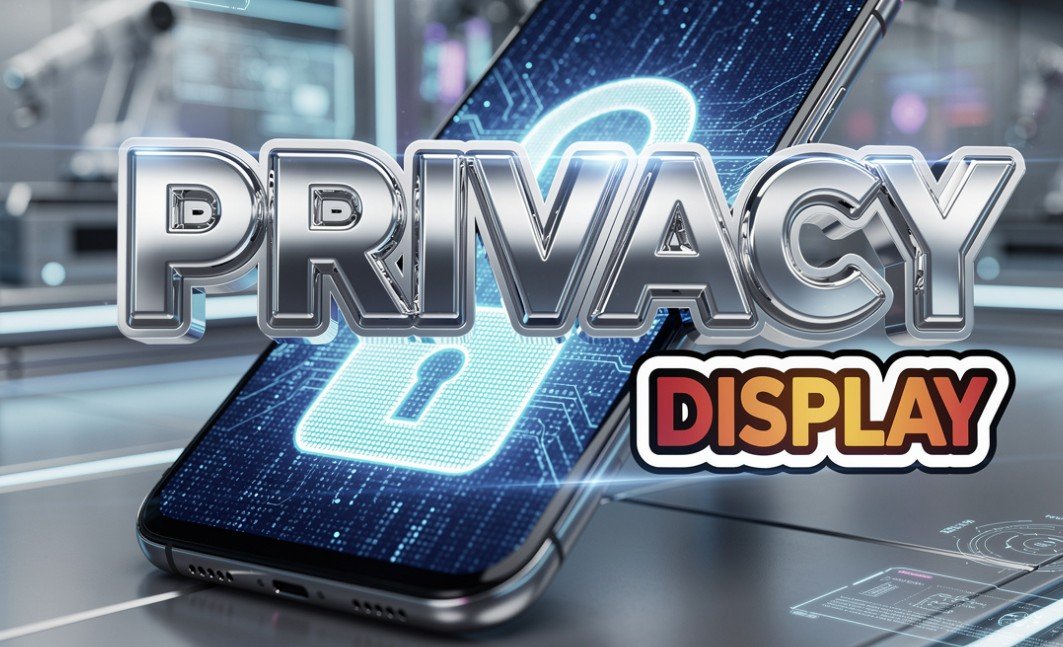
The true power of this technology lies in how granular the control is for the user. Samsung has not just added a simple on/off switch; they have integrated the feature with the phone’s new Agentic AI capabilities. You can now configure the Privacy Display to trigger automatically based on specific contexts or applications.
- Banking Apps: The screen instantly narrows viewing angles when you open your finance apps.
- Partial Screen Privacy: Only the area displaying a notification pop-up becomes invisible to bystanders, leaving the rest of the screen bright.
- Location-Based Triggers: The phone senses when you leave your home Wi-Fi and enter a public transit zone, enabling privacy mode automatically.
“Users can limit privacy to specific parts of the screen or customise when it activates, making discreet protection feel seamless and intuitive,” Park noted. This flexibility addresses a key pain point: we want privacy in public, but we want our vibrant, edge-to-edge display quality when we are safe at home.
Engineering A Global Security Standard
While the glitzy launch happened in San Francisco, the engineering backbone of the Galaxy S26 series has a massive footprint in India. Park revealed that engineers at Samsung’s R&D centres in Bengaluru and Noida played a critical role in “calibrating” these components to work with the Android operating system.
Key R&D Contributions:
| Feature | Development Hub | Impact |
|---|---|---|
| Component Calibration | Bengaluru | Ensures privacy hardware works with Android OS without lag. |
| Network Optimisation | Noida | Configures 5G/6G frequencies for 129 countries. |
| Contextual AI | Noida/Bengaluru | Adaptation of Bixby and Gemini agents for local languages. |
This collaboration highlights a shift in how flagship devices are built. It is no longer just about assembling parts in Korea; it is about global engineering integration. Park emphasized that the Noida facility is not just manufacturing the units for the local market but is instrumental in the software calibration that makes features like the Privacy Display responsive and battery-efficient.
Privacy in the Age of AI Agents
The push for hardware-level privacy comes at a crucial time. The Galaxy S26 series introduces “Agentic AI,” where on-device agents like Google Gemini and an upgraded Bixby actively perform tasks for you, from booking rides to summarising confidential work documents. When your phone is doing more sensitive work, the screen displaying that work becomes a higher-value target for snoops.
With the S26 Ultra, Samsung is betting that as our phones become smarter personal assistants, the physical screen must become a secure vault. By combining on-device data processing with a display that physically blocks onlookers, they are building a fortress that fits in your pocket. The technology acknowledges that digital privacy is useless if someone can just read your password over your shoulder.
The Galaxy S26 Ultra is not just an upgrade; it is a reimagining of personal space in the digital world. By baking privacy into the glass and pixels, Samsung has set a new benchmark that competitors will scramble to copy. It empowers users to define who they are to the world, on their own terms, without hiding behind a piece of dark plastic.