
The Sun unleashed a series of coronal mass ejections in November 2025, slamming into Earth and sparking intense geomagnetic storms. These events, peaking around mid-month, caused stunning auroras visible far south and minor tech disruptions across several continents.
Recent Solar Activity Surge
Solar activity ramped up dramatically this month as the Sun hit its peak in the 11-year cycle known as solar maximum. Multiple flares and ejections erupted from active regions on the Sun’s surface, with several directly aimed at Earth.
Experts tracked four major X-class flares from sunspot AR4274, the strongest being an X5.1 event on November 11. This flare launched a fast-moving coronal mass ejection traveling at about 1500 kilometers per second.
By November 12, the first impacts arrived, boosting solar wind speeds to 1000 kilometers per second. Geomagnetic conditions escalated to strong storm levels, lasting several hours before easing.
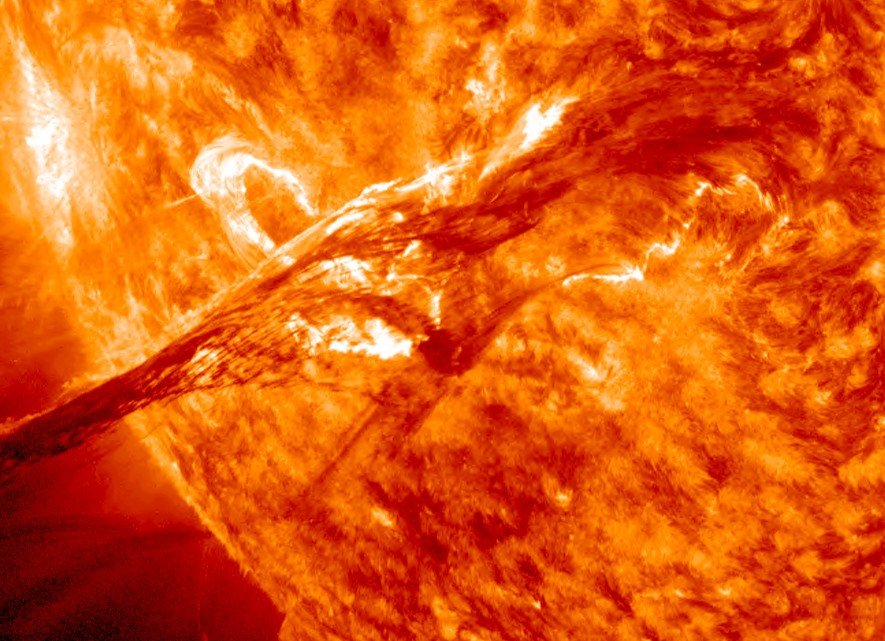
A follow-up ejection on November 21 added to the chaos, with solar wind peaking at 465 kilometers per second. No major storms followed immediately, but the Sun’s southeast region showed signs of more activity.
Impacts on Earth and Technology
These ejections triggered widespread effects, from beautiful light shows to potential risks for infrastructure. Auroras lit up skies as far south as Florida in the US, drawing crowds of skywatchers.
Radio blackouts hit parts of Africa, Europe, and Asia, lasting 30 minutes to an hour during peak flares. GPS signals and some communication systems faced brief interruptions, though overall disruptions stayed minimal.
Power grids and satellites experienced minor voltage fluctuations, but no widespread outages occurred. Space agencies collected valuable data on radiation levels, aiding future mission planning.
- Radio blackouts affected high-frequency communications in sunlit areas.
- Auroras were visible in northern US states and much of Canada.
- Satellite operators adjusted orbits to avoid charged particle damage.
One rare event was a ground level enhancement, where solar particles pierced Earth’s magnetic shield. Detectors on the ground picked up these high-energy intruders, marking a key moment for scientists.
The Science Behind Coronal Mass Ejections
Coronal mass ejections are massive bursts of plasma and magnetic fields from the Sun’s outer atmosphere. They can travel millions of kilometers, interacting with Earth’s magnetosphere upon arrival.
During solar maximum, sunspots increase, leading to more flares and ejections. This cycle’s peak arrived earlier than expected in 2025, fueling the recent barrage.
| Event | Date | Strength | Key Impact |
|---|---|---|---|
| X5.1 Flare | November 11 | Strongest of 2025 | Radio blackouts in Africa and Europe |
| CME Arrival | November 12 | Speed 1500 km/s | Strong geomagnetic storm, auroras in US |
| M7.4 Flare | November 5 | High | Partial Earth-directed CME |
| Narrow CME | November 21 | Moderate | Solar wind peak at 465 km/s |
These interactions create geomagnetic storms, rated on a scale from G1 minor to G5 extreme. November’s storms reached G4 severe levels, the highest this year.
Particles from ejections compress Earth’s magnetic field, allowing energy to flow into the atmosphere. This excites gases, producing colorful auroras while posing risks to electronics.
Historical Context and Comparisons
Past solar storms offer lessons for today. The 1859 Carrington Event, a massive ejection, disrupted telegraphs worldwide and sparked auroras in the tropics.
More recently, a 2003 storm caused blackouts in Sweden and damaged satellites. November 2025’s events, while strong, fell short of these extremes, thanks to better forecasting.
Space weather prediction has improved with tools like NASA’s Solar Orbiter and NOAA’s monitoring. These helped warn of incoming ejections days in advance.
The Sun’s activity ties into broader climate patterns, though not directly causing weather changes on Earth. Scientists note increased storm frequency during maximum phases.
What to Expect Next
The Sun remains active, with new coronal holes potentially sending high-speed winds our way. Forecasters predict unsettled conditions through late November, with possible minor storms.
A southeast coronal hole could become geoeffective soon, raising solar wind speeds again. No immediate severe storms are forecast, but vigilance continues.
Experts advise satellite operators and airlines to stay alert for radiation spikes. For the public, this means more chances to spot auroras in northern latitudes.
Preparation includes hardening power grids and developing better early warning systems. As solar maximum continues into 2026, similar events may recur.
Staying Safe and Informed
While these storms posed no direct health risks, they highlight our vulnerability to space weather. Simple steps like backing up data and monitoring alerts can help.
Share your aurora sightings or thoughts in the comments below. Did you catch the lights? Spread the word by sharing this article with friends interested in space news.
