In a stunning medical feat at King’s College Hospital in London, 65-year-old Denise Bacon played her clarinet while awake during deep brain stimulation surgery to treat her Parkinson’s disease. This recent procedure, performed in July 2025, showed instant improvements in her finger movements, allowing her to regain control over her beloved instrument after years of struggle.
The Remarkable Surgery Unfolds
Denise Bacon, diagnosed with Parkinson’s in 2014, faced growing challenges that robbed her of simple joys like walking, swimming, dancing, and playing music. Surgeons at King’s College Hospital decided on deep brain stimulation, a technique that implants electrodes in the brain to manage symptoms.
During the four-hour operation, Bacon stayed awake. This let the team monitor her responses in real time. Neurosurgeon Professor Keyoumars Ashkan led the procedure, numbing her scalp and skull but keeping her brain active for feedback.
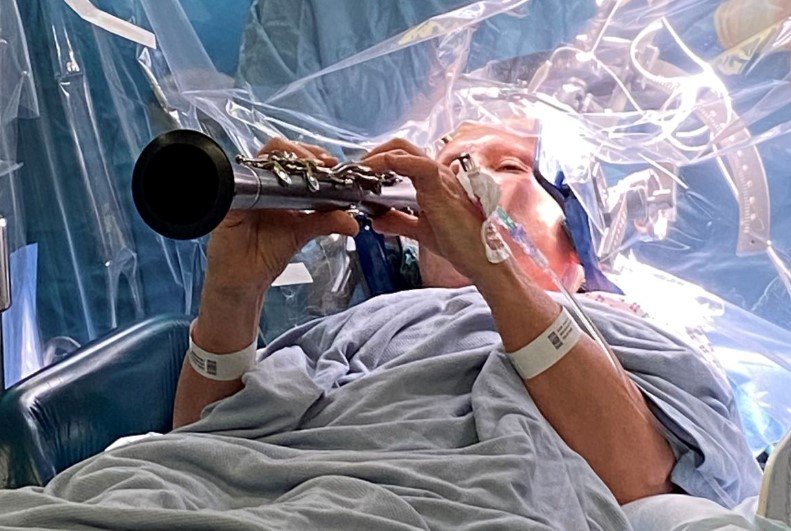
Bacon brought her clarinet to the operating room at the doctors’ suggestion. As electrodes activated, she played notes, giving surgeons audible proof of success. The moment marked a personal victory and a precise way to adjust the implants.
Instant Improvements on Display
Right on the operating table, changes appeared. Bacon’s fingers, once stiff and unresponsive, moved with new ease. She played scales and tunes she had not managed in five years.
Post-surgery reports show broader gains. Bacon now walks better and feels more steady. Doctors called the results instant, a common outcome in well-targeted deep brain stimulation cases.
This event echoes other awake surgeries where patients perform tasks to guide doctors. For instance, a violinist played during tumor removal in 2020 at the same hospital, preserving her skills.
Bacon, a retired speech therapist from Crowborough in Sussex, shared her delight. She described the experience as life-changing, restoring hope after a decade of decline.
Understanding Deep Brain Stimulation
Deep brain stimulation treats advanced Parkinson’s by sending electrical pulses to specific brain areas. It acts like a pacemaker for the brain, easing tremors, stiffness, and slow movement.
The process starts with imaging to map the brain. Surgeons drill small holes in the skull, insert electrodes, and connect them to a chest device. Patients often stay awake to help fine-tune placement.
Over 160,000 people worldwide have undergone this since its approval in the late 1990s. In the UK, about 145,000 live with Parkinson’s, and cases rise as the population ages.
- Reduces medication needs for many patients
- Improves quality of life by up to 50 percent in studies
- Targets symptoms that drugs alone cannot control
While not a cure, it offers lasting relief for those with severe symptoms.
Denise Bacon’s Journey with Parkinson’s
Bacon’s story began with subtle signs like tremors and fatigue. By 2019, symptoms worsened, forcing her to stop playing in her local band. She tried various therapies, but nothing fully helped.
Support from family and Parkinson’s UK kept her going. The charity notes that one in 37 people risk developing the condition in their lifetime.
Choosing surgery was tough, but Bacon saw it as a chance to reclaim her passions. Her case highlights how personalized care can transform lives.
Recent data from 2025 shows Parkinson’s diagnoses increasing by 5 percent yearly in the UK, driven by better awareness and longer lifespans.
Broader Impact on Parkinson’s Treatment
This surgery spotlights advances in neurology. Experts predict more awake procedures as technology improves, making them safer and more effective.
Similar cases include a man whose tremors stopped instantly during stimulation, captured in viral videos. These stories inspire hope and encourage early intervention.
Research from the Michael J. Fox Foundation pushes for better treatments. In 2025, new trials explore gene therapy alongside stimulation.
| Aspect | Details |
|---|---|
| Procedure Time | 4 hours |
| Key Benefit | Instant symptom relief |
| Global Patients | Over 160,000 treated |
| UK Parkinson’s Cases | About 145,000 |
| Success Rate | Up to 80 percent for eligible patients |
Such innovations could reduce the economic burden, estimated at 3.3 billion pounds annually in the UK for care and lost productivity.
Looking Ahead for Patients Like Bacon
Bacon continues to recover, with follow-up adjustments to her device. She plans to return to her band and enjoy daily activities without constant struggle.
Doctors monitor her progress, noting that full benefits may emerge over months. This case could encourage others to consider deep brain stimulation sooner.
As research evolves, stories like Bacon’s remind us of medicine’s power to blend science with human spirit.
Share this inspiring story with friends facing similar challenges, and comment below on how medical breakthroughs have touched your life.