
Jill Edwards says Georgia cannot investigate itself, citing international law concerns as injuries mount and official answers remain missing.
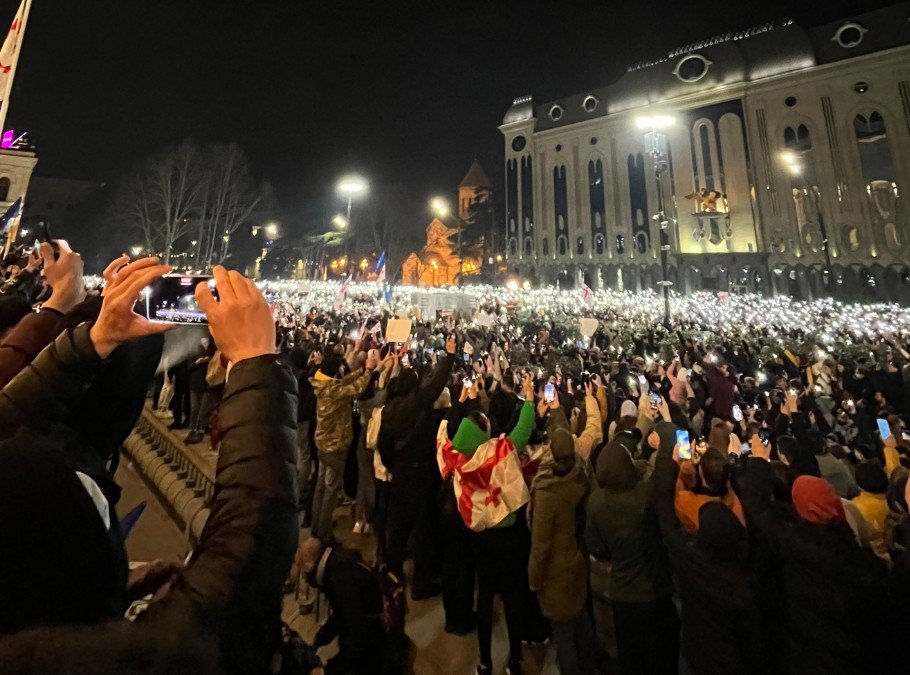
As protests in Georgia continue to draw international attention, the United Nations has stepped in with unusually sharp words. Jill Edwards, the UN Special Rapporteur on Torture, says serious questions remain unanswered about whether chemical agents were used against demonstrators, and whether the Georgian government is capable of investigating itself.
Her remarks, given in an interview with the independent broadcaster Formula, land at a sensitive moment for the Georgian Dream government. Allegations of excessive force, unexplained injuries, and possible use of experimental crowd-control tools are now being discussed well beyond Tbilisi.
“A government cannot investigate itself,” Edwards says plainly
Edwards did not mince words when asked about the Georgian authorities’ internal probes into the dispersal of protests.
One sentence stood out. A government, she said, cannot investigate its own actions.
That principle, she stressed, sits at the core of international law. Transparency, independence, and impartiality are not optional extras. They are requirements.
She urged Georgian Dream to activate external oversight through Council of Europe mechanisms, noting that Georgia remains bound by many European human rights standards even though it is not an EU member state.
In her view, internal reviews alone do little to restore trust, especially when allegations involve potential torture or the use of weapons against civilians.
Precedent from Serbia looms large in the discussion
Edwards pointed to a recent example that has caught the attention of human rights lawyers across Europe.
In Serbia, President Aleksandar Vučić faced accusations of using acoustic weapons against protesters. The response was swift. The European Court intervened and banned Serbian authorities from deploying sound-based crowd-control devices.
The comparison was deliberate.
She described acoustic weapons and chemical agents as experimental tools whose effects are still not fully understood, especially when used in dense crowds.
There is precedent, she said, for international scrutiny and legal limits. Georgia, in her words, should follow that path.
One short line summed up her position. There is no legal vacuum here.
Questions around chemical agents remain unanswered
Edwards revealed that she, along with other UN special rapporteurs, formally contacted the Georgian government.
So far, she says, there has been no official response.
She has not received detailed information on:
-
What chemical agents were allegedly used
-
How they were deployed
-
What investigations have already been conducted
Until that information is shared, she said, much remains unclear.
That silence, according to human rights observers, is fueling suspicion rather than calming it. Transparency, they argue, would help the government’s case if it believes it acted within the law.
Right now, uncertainty dominates.
Disproportionate injuries raise red flags
One of the most troubling aspects for the UN rapporteur is the injury data emerging from the protests.
Edwards said the number of injuries appears disproportionate to the size of the demonstrations.
She also noted that the injury rate seems unusually high compared with similar protests in other countries. That comparison matters. International norms rely heavily on patterns.
Of particular concern is the volume of head injuries reported among protesters.
She described this trend as dangerous and said it demands urgent investigation, both to establish responsibility and to ensure proper medical care.
Some injured individuals, she warned, may require long-term treatment.
That possibility alone, she said, raises the stakes considerably.
Police conduct and the question of “weapons”
In her interview, Edwards used a word that quickly made headlines in Georgian media.
Weapon.
She applied it to the methods reportedly used by police during the dispersal of protests, framing them within the context of torture and ill-treatment standards under international law.
There are clear rules, she emphasized, governing how police should manage assemblies. These rules focus on legality and proportionality.
Proportionality, she said, appears to be a major issue in Georgia’s case.
That does not automatically mean violations occurred. But it does mean closer examination is required, especially when force results in widespread injuries.
A single sentence captured her concern. These trends are alarming.
Whistleblower claims deepen the controversy
The debate intensified further after a former Georgian interior ministry officer, Lasha Shargelashvili, publicly claimed that a toxic chemical agent had been used in Tbilisi.
According to Shargelashvili, the substance was tested years ago, possibly as early as 2009, and was deemed too toxic for use.
His statement has not been independently verified. Still, it has circulated widely, adding pressure on authorities to clarify what exactly was deployed during the protests.
Officials have denied wrongdoing, but detailed technical explanations remain scarce.
For human rights monitors, the combination of whistleblower testimony, injury patterns, and official silence creates a troubling picture.
Media scrutiny and government pushback intensify
The controversy has also spilled into a parallel dispute over press freedom.
Georgian authorities have accused the BBC of spreading false information related to the protests. The government has even threatened legal action.
The BBC, for its part, has publicly defended its reporting, stating it stands by its journalism.
That standoff underscores how tense the environment has become. International media coverage is amplifying pressure, while government responses appear increasingly defensive.
