
The United States will take control of Venezuela and sell seized oil assets until a political transition is complete, President Donald Trump said Saturday, following U.S. military strikes that he claimed resulted in the capture of Venezuelan President Nicolás Maduro and his wife.
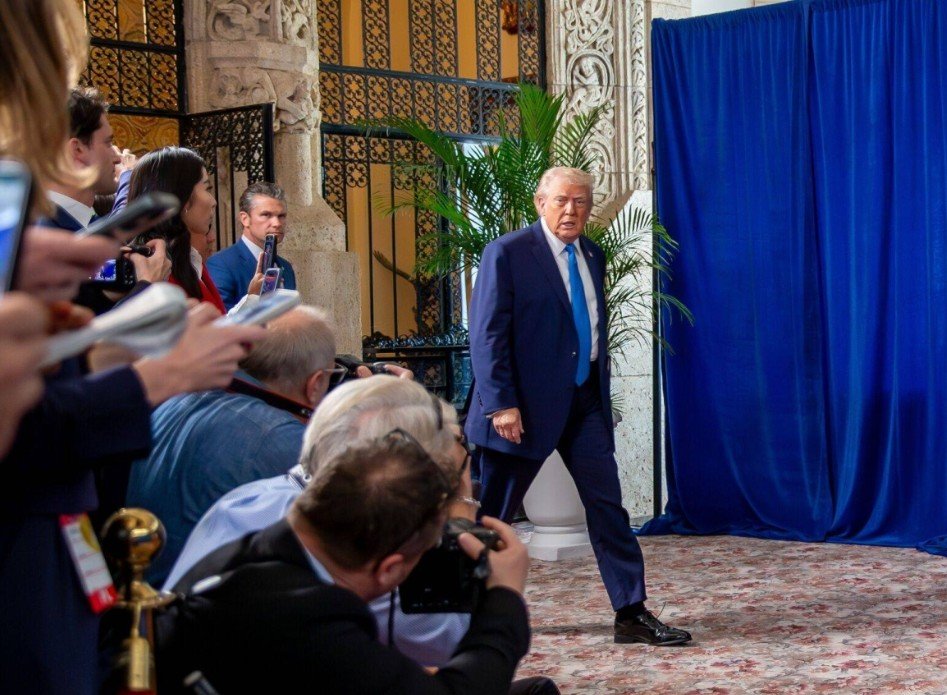
Speaking from his Mar-a-Lago resort in Florida, Trump framed the operation as necessary for regional stability, economic interests, and what he described as a reset for Venezuela’s future.
A sudden escalation capped by extraordinary claims
The president’s remarks followed a chaotic sequence of events that began with reports of explosions in Caracas early Saturday.
For hours, details were unclear. Then Trump addressed reporters and laid out a sweeping narrative. He said U.S. forces were already on the ground, that Washington would oversee Venezuela’s governance for a period, and that Maduro and his wife, Cilia Flores, had been captured.
According to Trump, the two are being transported aboard the USS Iwo Jima to New York, where they would face trial. U.S. officials have not publicly detailed the legal framework for such proceedings, but the president spoke with confidence.
“We’re there now,” Trump said. “We’re going to stay until such time as the proper transition can take place.”
The comments instantly sent shockwaves through diplomatic circles.
What Trump says U.S. control would look like
Trump described the U.S. role in blunt terms.
“We’re going to run it, essentially,” he said, adding that the goal was to stabilize the country before handing it over to new leadership.
He argued that Venezuela’s future directly affects American interests, especially in the Western Hemisphere. Stability, he said, begins with neighbors that Washington considers reliable.
“We want to surround ourselves with good neighbors,” Trump told reporters. “We want stability.”
Trump also named senior officials who would be involved in managing the transition, including Secretary of State Marco Rubio and Defense Secretary Pete Hegseth. He suggested the U.S. would effectively supervise security, energy operations, and political restructuring.
It was a vision closer to trusteeship than traditional intervention.
Boots on the ground, and no apology for it
Trump made clear he had no intention of downplaying the military role.
“We’re not afraid of boots on the ground,” he said, confirming U.S. forces were already operating inside Venezuela during the strikes. He described the deployment as “very high level,” without offering operational details.
The language marked a sharp departure from years of U.S. rhetoric that emphasized sanctions and diplomatic pressure rather than direct force.
Defense analysts say such statements, delivered so openly, are unusual even by Trump’s standards. They also raise immediate questions about scope, duration, and the rules governing U.S. troops.
Trump dismissed concerns that the action could spiral, insisting it was purposeful.
“We’re not doing this in vain,” he said.
Oil at the center of the plan
Energy played a central role in Trump’s explanation.
He said the U.S. would seize Venezuelan oil assets and sell the output, with proceeds split between Venezuela’s people and the United States. Trump framed the move as both economic justice and strategic necessity.
“We’re going to be taking out a tremendous amount of wealth out of the ground,” he said. “That wealth is going to the people of Venezuela… and it goes also to the United States of America.”
Trump also said U.S. oil companies would move into the region with military backing, a remark that immediately drew scrutiny from critics who argue the intervention risks being seen as resource-driven.
Here’s what Trump outlined in broad strokes:
-
U.S. oversight of Venezuelan oil production
-
Sales of seized oil on international markets
-
Revenue shared between Venezuela and the U.S.
-
Military protection for American energy firms
No timeline was provided, and no formal plan has yet been released by the administration.
Maduro’s reported capture raises global stakes
Trump’s assertion that Venezuelan President Nicolás Maduro and his wife were captured represents one of the most dramatic claims tied to U.S. foreign policy in decades.
Maduro has been a central figure in Venezuela’s long-running political and economic crisis, maintaining power despite international sanctions and opposition recognition efforts.
If confirmed, his detention would mark a turning point not just for Venezuela, but for regional politics across Latin America.
As of Saturday evening, independent verification from Venezuelan authorities or international observers remained limited. Markets, however, reacted immediately, with oil traders watching closely for confirmation and clarity.
Diplomats in the region privately expressed concern about the precedent such an action could set.
International reaction still forming
Foreign governments were still assessing the situation as Trump spoke.
Latin American leaders have historically resisted direct U.S. military involvement in the region, even when critical of Caracas. European allies, meanwhile, have favored negotiations and elections over force.
Analysts say Trump’s remarks leave little room for ambiguity. By declaring that the U.S. will “run” Venezuela, Washington appears to be claiming responsibility for whatever follows.
That includes governance, humanitarian conditions, and potential unrest.
One former U.S. diplomat described the moment as “a line crossed in public, not behind closed doors.”
Legal and political questions ahead
Trump did not address how U.S. control would align with international law, nor did he explain how long American oversight would last.
Congressional leaders from both parties are expected to demand briefings. Some lawmakers have already raised questions about authorization, funding, and exit strategy.
Human rights groups are also watching closely, particularly regarding civilian protections during ongoing operations.
At the same time, Trump’s supporters argue the move demonstrates decisiveness after years of stalemate in Venezuela.
Basically, the debate is just getting started.
A defining moment with uncertain consequences
Trump’s comments capped a day that shifted U.S.–Venezuela relations into uncharted territory.
By combining military action, regime capture claims, and explicit plans to manage and profit from oil production, the president laid out a vision that challenges decades of American foreign policy norms.
What happens next depends on facts still emerging: confirmation of Maduro’s status, reactions from Venezuelans themselves, and whether U.S. allies support or resist Washington’s course.
