
Trump agrees to support fragile truce after phone call with Cambodian PM; Thai army accuses Cambodia of violating agreement within hours
The guns may have fallen silent—at least for now—but trust hasn’t returned to the jungles dividing Thailand and Cambodia. Just hours after both nations signed an unconditional ceasefire, Thailand’s army accused Cambodian forces of opening fire in contested territory, reigniting fears that the truce may already be on shaky ground.
The ceasefire, brokered during Monday’s emergency peace talks in Malaysia, was meant to halt a bloody flare-up over disputed land near centuries-old temple ruins. But by Tuesday morning, Thai military officials claimed fresh clashes had erupted—despite the ink barely drying on the agreement.
Trump promises U.S. support in overseeing peace
In an unexpected turn, Cambodian Prime Minister Hun Manet revealed that U.S. President Donald Trump had pledged American involvement in monitoring the ceasefire. The two leaders spoke by phone shortly after the truce was announced.
“Trump agreed that the U.S. will participate in monitoring the ceasefire and will help to maintain it,” Hun Manet told Kyodo News.
This marks one of the most direct U.S. involvements in a Southeast Asian land dispute in years. While Washington has historically maintained a more hands-off approach in regional border clashes, the latest violence—paired with China’s growing military footprint—may have altered that calculus.
Trump’s commitment comes at a time when both countries seem reluctant to fully trust each other, even as they gesture toward peace.
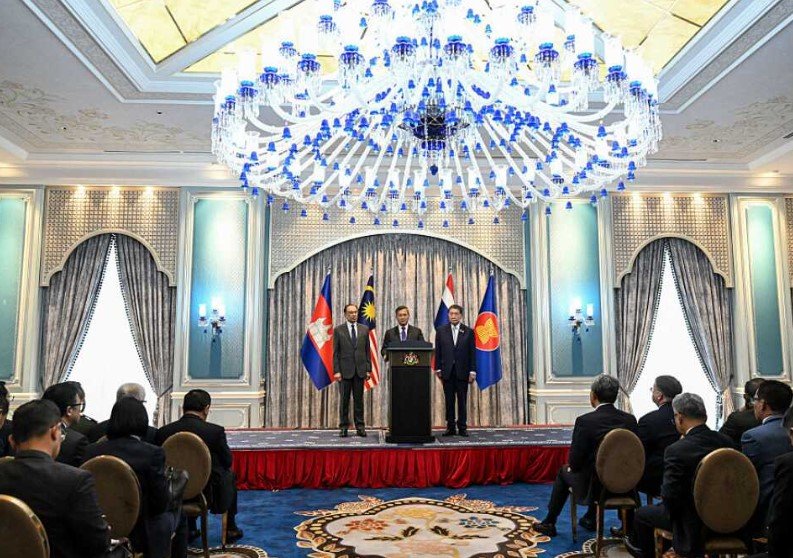
Ceasefire or staged pause?
While officials on both sides talked peace, things looked different on the ground.
As midnight approached on Monday night, an AFP reporter stationed in Samraong, Cambodia—just 20 kilometers from the frontier—reported a lull in the gunfire. The booming blasts that had haunted the city for days suddenly stopped.
But not for long.
Thailand’s military says Cambodian troops opened fire in multiple areas just after midnight—allegedly targeting Thai checkpoints in contested jungle areas.
Army spokesman Col. Winthai Suwaree didn’t mince words. “This constitutes a deliberate violation of the agreement,” he said. “Thailand is compelled to respond appropriately, exercising its legitimate right to self-defense.”
One sentence here. Cambodian officials, of course, denied any aggression.
Blame and disbelief on both sides
Maly Socheata, Cambodia’s Defense Ministry spokesperson, called the Thai accusation “completely baseless.” According to her, “There have been no armed clashes against each other in any regions.”
Still, even locals aren’t convinced the truce will hold. In Surin, a Thai border city just 50 kilometers away, many residents remain deeply skeptical.
“I saw photos of the two leaders shaking hands,” said Kittisak Sukwilai, a pharmacy worker. “I just hope it’s not just a photo op with fake smiles — and that those hands aren’t actually preparing to stab each other in the back.”
In Cambodia, residents voiced similar doubts. Some cautiously welcomed the silence, but few were celebrating.
What’s this war really about?
At the heart of the conflict is a long-standing territorial dispute over stretches of jungle along the 800-kilometre (500-mile) border. The flashpoints are mainly ancient temples and surrounding forested hills claimed by both nations.
The most contested of them, the Preah Vihear temple, has long been a lightning rod for nationalist sentiment on both sides.
Though the International Court of Justice ruled in 1962 that the temple belonged to Cambodia, it left the surrounding land open to interpretation—a loophole that has repeatedly led to flare-ups, including deadly skirmishes in 2008 and 2011.
-
Key Flashpoints: Preah Vihear, Ta Moan, and Ta Krabey temple areas
-
Past Clashes: 2008, 2011, 2025
-
Number of Displaced (2025, est.): Over 17,000
-
Casualties Reported (past week): At least 23 dead, dozens injured
One sentence here. History, nationalism, and disputed maps are fueling the fire.
Morning meetings or morning missiles?
As part of the truce agreement, regional commanders from both armies were supposed to hold early morning meetings Tuesday to prevent further misunderstandings and disengage troops.
Some of those meetings did reportedly begin.
Others, not so much.
A Cambodian officer told EurAsian Times that several Thai units didn’t show up at their designated meeting points. Thai sources say they were targeted before they could even get there.
With both sides pointing fingers, the credibility of the truce already looks thin.
Table: Key Events Since Border Clashes Escalated
| Date | Event |
|---|---|
| July 22, 2025 | Fighting erupts near Preah Vihear temple |
| July 25, 2025 | 12 Thai and 8 Cambodian soldiers killed in intense shelling |
| July 28, 2025 | Peace talks held in Kuala Lumpur, Malaysia |
| July 29, 2025 | Ceasefire announced; Trump, Hun Manet phone call confirmed |
| July 30, 2025 | Thai Army accuses Cambodia of breaching ceasefire |
One sentence here. Five days, five chances for disaster.
U.S. caught in a delicate balancing act
The U.S. now finds itself in an awkward position. Trump’s offer to monitor the ceasefire adds American credibility to the agreement—but also stakes U.S. prestige on its success.
Analysts warn that unless Washington steps up its regional diplomacy, this ceasefire could unravel quickly. The Biden administration in its final days had warned about rising flashpoints across Asia. Trump, returning to the stage, now has to show whether he can contain one.
Some believe the move is meant to show strength in contrast to China’s tight grip over similar regional disputes in the South China Sea.
“Trump wants to remind Southeast Asia that the U.S. is still the ultimate referee,” said Dr. Apichai Suksomboon, a Bangkok-based geopolitical analyst. “But if the truce collapses in 48 hours, that credibility takes a hit.”
