
Skywatchers around the world are being treated to a once‑in‑a‑few‑years cosmic spectacle as six planets spread across the evening sky in what’s popularly being called a planetary parade. This rare alignment — featuring Mercury, Venus, Jupiter, Saturn, Uranus and Neptune — has captured the imagination of amateur stargazers and scientists alike. What makes this event especially exciting is how many of these worlds can be seen with the naked eye, while others appear with simple binoculars or telescopes.
Whether you’re a seasoned astronomer or someone who simply enjoys stepping outside after sunset, this celestial display is something few of us will forget. From India to Europe, from the Americas to Australia, the night sky is offering a glimpse of our solar system in motion — all without complex equipment.
What the Planet Parade Is and Why It Happens
Most people think of stars and planets as random dots in the sky. But this week something unusual is unfolding. Six planets are aligned across the evening sky, creating the illusion of a line or arc stretching above the horizon. Astronomers call this a planetary parade, though it isn’t a procession in space. It’s simply the result of seeing planets from Earth when their orbits place them on the same side of the Sun in roughly the same direction.
Planets orbit the Sun in nearly the same flat plane. From Earth’s point of view, that shared plane causes them to appear along a gentle curve after sunset when conditions are right. This sequence doesn’t mean they are physically lined up, but the visual effect is striking and memorable.
The planets in this parade are:
-
Mercury
-
Venus
-
Jupiter
-
Saturn
-
Uranus
-
Neptune
Four of them — Venus, Jupiter, Saturn and Mercury — can often be seen with the unaided eye under clear skies. The other two, Uranus and Neptune, are faint and usually require binoculars or a small telescope to be spotted.
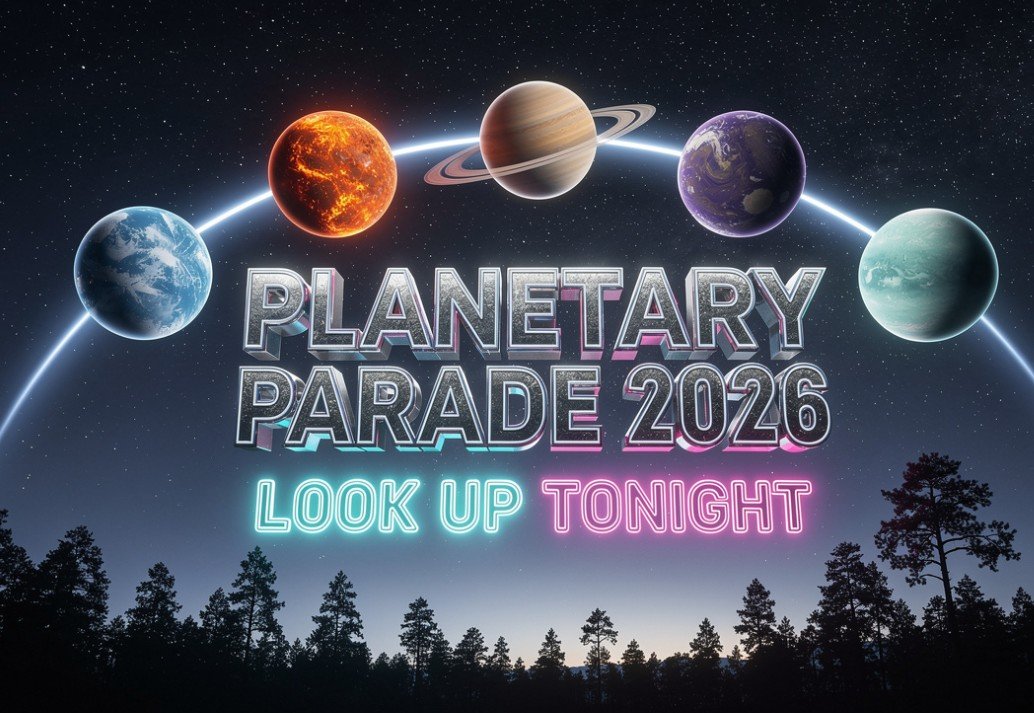
How to Watch the 2026 Planetary Parade
Timing is key when it comes to catching this celestial event. Astronomers and science organisations agree that the optimal viewing window is about 30 to 45 minutes after local sunset, when the planets are visible above the western horizon before they fade into twilight.
Here’s how to get the best view:
• Find a clear western horizon with minimal buildings or trees blocking the sky. Skywatchers recommend stepping outside about 20 to 30 minutes after sunset to catch all visible planets at once.
• Look for Venus first. It’s the brightest of the group and will shine like a brilliant jewel low in the western sky.
• Spot Jupiter higher in the sky. It will often appear well above the horizon and glow as one of the brightest objects.
• Use binoculars or a small telescope to find Uranus and Neptune. These distant, dim planets are part of the alignment but are too faint to see with the naked eye.
This alignment isn’t limited to a single night. Observers can step outside for several evenings around February 28 and catch the show. Clear skies and good weather will make it easier to spot planets like Mercury and Saturn near the horizon before they disappear into twilight.
Where This Spectacle Is Visible
The planetary parade is visible from virtually every continent. Reports from astronomy clubs and science outlets note that this event is not just a thin slice of the globe — it’s a global opportunity. From bustling metros with light pollution to quiet rural areas under dark skies, skywatchers can find a location that works for them.
In India, cities such as Delhi, Mumbai, Kolkata, Chennai and Bengaluru offer rooftop views of the parade, especially if observers face the western horizon and the skies are clear. For darker skies and better viewing of faint planets like Uranus and Neptune, rural areas with minimal light pollution are ideal.
Across Europe and the UK, observers are being told to look about 30 minutes after sunset. Venus and Jupiter will be especially bright in the evening twilight, while the other planets will require optical aids.
Even in North America and Australia, similar guidelines apply. Skywatchers everywhere are being urged to make time this week to witness the parade before the planets drift further apart in the months ahead.
What Makes This Event Special
Planetary alignments are not unheard of, but seeing six planets in a single span of sky is relatively rare. It’s unusual to catch this many worlds visible at once without waiting for decades of preparation. Astronomers note that events like this generate widespread interest because they allow people to connect with our solar system in a very real way.
To put it in perspective, Mars will not be part of this particular parade because it will be on the opposite side of the Sun from Earth at this time. Nevertheless, the lineup from Mercury to Neptune provides a full view of planets from both inner and outer parts of our solar system.
This parade also aligns perfectly with other upcoming astronomical landmarks, including a total lunar eclipse on March 3, 2026, visible across multiple continents. Skywatchers who catch the planetary parade can keep their binoculars and telescopes ready for another celestial delight just days later.
Why You Should Step Outside Tonight
There is something deeply humbling about looking up and seeing other worlds in motion. For thousands of years, humans have gazed at the sky and tried to make sense of their place in the universe. Events like this remind us that we still share that same sky, even as cities and screens compete for our attention.
Whether you’re hosting a stargazing party, teaching children about the solar system, or simply taking a break from your daily routine, this planetary parade offers a moment of connection and wonder. The next visible alignment like this may not happen for many years, so make the most of it.
Let us know if you saw the planets tonight and what they looked like from your spot. Share your photos and thoughts using hashtag #SkyParade2026 and help others join this shared moment beneath the stars.
