
Scientists have unlocked the puzzle of a huge black hole crash detected in 2023, pointing to magnetic fields as the key force behind it. The event, called GW231123, involved two giant black holes smashing together seven billion light years away, and experts now explain how these monsters formed against all odds.
Discovery Shakes Up Space Science
The LIGO Virgo KAGRA team first spotted GW231123 through ripples in space time known as gravitational waves. This crash created waves that traveled across the universe and reached Earth detectors.
These waves came from two black holes, one about 140 times the suns mass and the other around 100 times. They merged into a single beast weighing 225 solar masses, making it the biggest such event ever recorded.
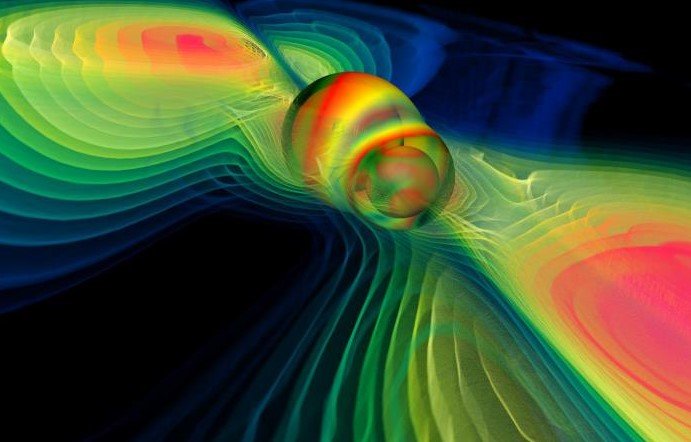
Astronomers announced this find in mid 2025, sparking worldwide interest. The detection challenged old ideas about how black holes grow and merge in distant galaxies.
Recent studies show this merger happened in a dense star cluster, where gravity pulls objects close. Experts used computer models to recreate the scene, revealing details about the violent process.
Why These Black Holes Should Not Exist
Stars usually form black holes when they die, but there is a limit. Massive stars between 70 and 140 solar masses often blow up completely in pair instability supernovas, leaving no black hole behind.
GW231123 broke this rule with its huge sizes. Scientists wondered how such giants could survive without exploding away.
New research suggests these black holes formed from smaller ones merging over time. This process happens in crowded areas of space, where collisions are common.
The spins of these black holes were extreme, adding to the mystery. Fast spins hint at past mergers, as each crash boosts rotation speed.
Here are key facts about black hole limits:
- Normal stellar black holes top out at 65 solar masses from single star deaths.
- Pair instability gap blocks formation between 65 and 120 solar masses.
- GW231123 black holes jumped this gap, forcing experts to rethink theories.
Magnetic Fields Provide the Missing Piece
The breakthrough came from looking at magnetic forces around these black holes. Strong magnetic fields can stabilize massive stars and prevent total destruction during explosions.
In simulations, scientists saw how magnetic fields hold star material together. This allows remnants to collapse into black holes instead of scattering into space.
Ore Gottlieb, a lead researcher, explained that magnetic effects create paths for black holes in forbidden mass ranges. His teams work, published in a major journal, used advanced models to test this idea.
These fields twist and amplify during star collapses, influencing the final black hole size and spin. This explains why GW231123 black holes spun so wildly.
Experts checked data from other mergers to confirm. Similar patterns appear in events like GW190521, supporting the magnetic theory.
What This Means for Future Discoveries
This finding opens doors to understanding universe secrets. It shows black holes can grow bigger than thought, changing views on galaxy evolution.
Astronomers predict more such detections with upgraded detectors. The next observing run could spot even larger mergers.
It also ties into primordial black holes, ancient remnants from the big bang. Some theories link them to dark matter, and this research adds clues.
| Event Name | Black Hole 1 Mass (Solar Masses) | Black Hole 2 Mass (Solar Masses) | Merged Mass (Solar Masses) | Distance (Billion Light Years) |
|---|---|---|---|---|
| GW231123 | 140 | 100 | 225 | 7 |
| GW190521 | 85 | 66 | 142 | 5 |
| GW200220 | 87 | 61 | 141 | 6 |
This table compares GW231123 with other major mergers, highlighting its record size.
The discovery boosts fields like gravitational wave astronomy. Teams worldwide collaborate to map these events and learn about cosmic history.
Challenges and Next Steps in Research
Skeptics question if magnetic fields alone explain everything. Some argue other forces, like dark matter interactions, might play a role.
To test ideas, scientists plan more simulations and observations. Upcoming telescopes could spot light flashes from similar crashes.
Funding for projects like LIGO grows, with billions invested in tech upgrades. This ensures better data on rare events.
International teams, including experts from India and Europe, contribute to analysis. Their work refines models and predicts future mergers.
As research evolves, it could reveal how the first black holes formed after the big bang.
Share your thoughts on this cosmic breakthrough in the comments below, and spread the word by sharing this article with fellow space enthusiasts.
