
The global energy market is facing its darkest hour in decades. Natural gas prices in Europe screamed higher by another 30 percent on Tuesday morning. This terrifying jump comes just 24 hours after a 40 percent surge on Monday. The panic started after QatarEnergy announced a complete halt to production following military attacks on its core facilities. Traders and governments are now staring at a worst-case scenario. The world’s second-largest supplier of liquefied natural gas has effectively gone offline.1
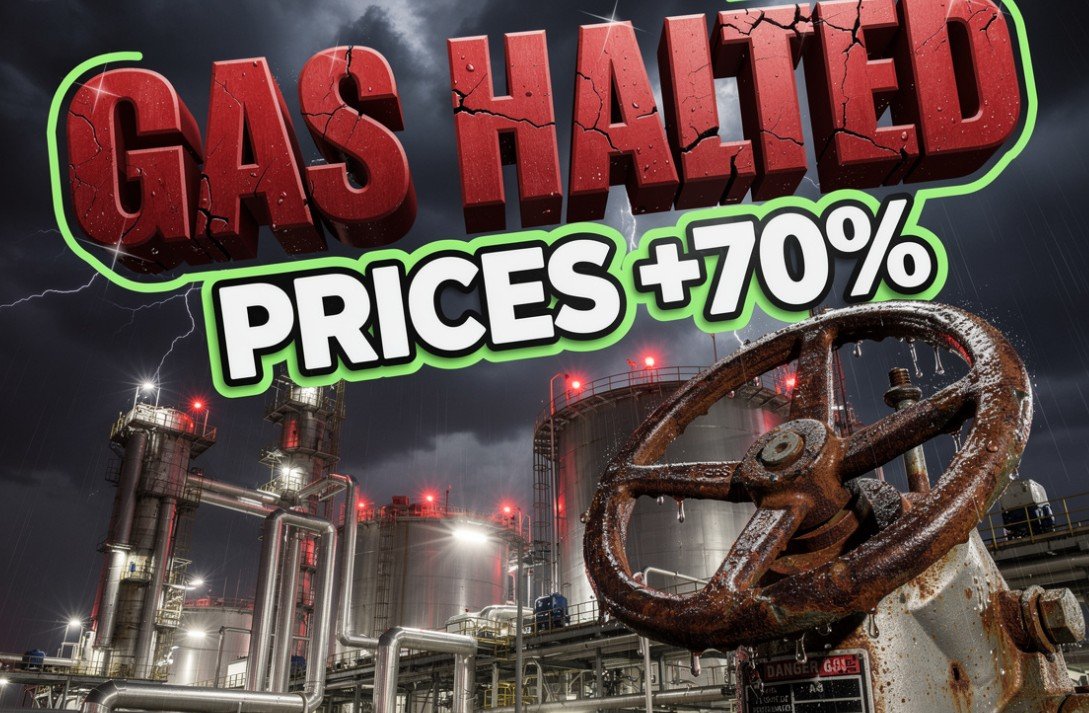
Markets are reacting with extreme volatility not seen since the crises of the early 2020s. The benchmark Dutch TTF gas price has now climbed nearly 70 percent in less than 48 hours. This is not just a fluctuating chart. This is a signal that heating homes and powering factories is about to become drastically more expensive for millions of people.
The Heart of Global Gas Stops Beating
The epicenter of this crisis is Ras Laffan Industrial City. This massive complex on Qatar’s northeast coast is the beating heart of the global LNG trade. It sits atop the North Field, which is the largest natural gas field in the world. When QatarEnergy announced they were ceasing production there and at the Mesaieed Industrial City to the south, the market went into shock.
Ras Laffan is not just a factory. It is a colossus of energy exports. It processes and ships billions of dollars worth of gas every year to keeping lights on from Tokyo to London. The attacks have forced a total shutdown of these critical operations.
Impact on Global Supply:
- Ras Laffan: Handles nearly all of Qatar’s LNG exports. Its closure removes a massive chunk of supply instantly.
- Mesaieed: A key hub for petrochemicals and fertilizers. Its shutdown threatens global farming and manufacturing supply chains.
- Total Loss: The market has lost access to the world’s most reliable “safety valve” for natural gas.
Experts warn that restarting these complex facilities is not like flipping a light switch. It requires safety checks, repairs and a secure environment. None of those conditions exist right now.
Europe’s Storage Nightmare
The timing could not be worse for Europe. The continent is just finishing a grueling winter that has drained its gas reserves. Official data from Gas Infrastructure Europe paints a grim picture. Storage sites are currently sitting at just 30 percent capacity. This is the lowest level recorded in five years.
Usually, March is when countries breathe a sigh of relief and start planning to refill tanks for the next winter. That plan is now in tatters.
Current European Gas Storage Status:
| Country | Estimated Storage Level | Status |
|---|---|---|
| Germany | 28% | Critical |
| France | 29% | Critical |
| Italy | 31% | Low |
| Netherlands | 25% | Severe |
Source: Estimates based on Gas Infrastructure Europe data trends.
The 30 percent figure is a red line. If storage dips much lower, pressure in the pipelines drops. This makes it physically harder to get the remaining gas out when it is needed most.
The Choke Point That Changed Everything
The crisis is not just about the damaged facilities. It is about the transport route. The Strait of Hormuz is the narrow waterway connecting the Persian Gulf to the open ocean. It is often called the world’s most important oil and gas artery.
Roughly 20 percent of all global LNG trade passes through this strait.7 With the military attacks ongoing, this route is now effectively a “no-go” zone for commercial tankers. Insurance companies are canceling coverage and captains are refusing to sail.
Even if Qatar could magically restart production today, the ships cannot leave. This leaves the global market with a massive hole in supply that no other country can fill quickly. The United States and Australia are the other big exporters. But their ships take weeks longer to reach Europe and their production is already maxed out.
A Bidding War with No Winners
A fierce competition is now erupting between Europe and Asia. In the past, Qatar sent a lot of its gas to Asian powerhouses like China, Japan and South Korea.Now that Qatari gas is trapped, these Asian nations are desperate.
They are turning to the spot market to buy up every available cargo from the United States or Nigeria. Europe is doing the same thing. This has created a bidding war where the price is the only weapon.
Why this competition is dangerous:
- Price Spirals: When two desperate buyers want the same cargo, the price can double in minutes.
- Cargo Diversion: Ships currently heading to Europe might turn around and sail to Asia if the price offered is higher.
- Energy Poverty: Wealthy nations will pay any price to keep the lights on. Developing nations will be priced out completely.
The reality is setting in that energy bills will soar. Governments may have to step in with subsidies or rationing if the blockage continues for more than a few weeks.
The shutdown of Qatari LNG production has plunged the world into an energy emergency. Prices have risen 70 percent in two days. The loss of production at Ras Laffan and the blockage of the Strait of Hormuz have cut off 20 percent of global supply. Europe is vulnerable with only 30 percent gas storage left. A bidding war between Europe and Asia is driving prices to record highs. Consumers should prepare for a period of extreme volatility and higher costs.
The situation is developing rapidly. We will continue to update this story as more information becomes available.
