
NASA’s Parker Solar Probe has set a new benchmark in space exploration by completing its 25th close flyby of the Sun on September 15, 2025, reaching speeds of up to 687,000 kilometers per hour. This achievement, managed from the Johns Hopkins Applied Physics Laboratory in Maryland, brings scientists closer to unlocking the Sun’s secrets while showcasing human ingenuity in extreme conditions.
Mission Background and Launch
The Parker Solar Probe launched in 2018 as part of NASA’s Living With a Star program. Its main goal is to study the Sun’s outer atmosphere, known as the corona, from closer than any spacecraft before.
Over the years, the probe has used Venus flybys to tighten its orbit around the Sun. This clever path allows it to dive deeper into solar regions that were once out of reach.
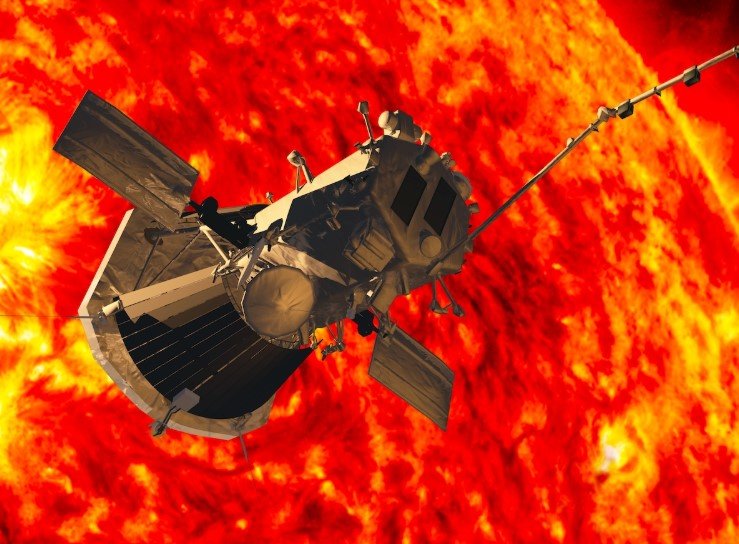
Engineers designed the probe to withstand intense heat and radiation. Its heat shield protects instruments during close approaches, where temperatures can hit thousands of degrees.
Record Speed and Close Approach
During this latest flyby, the probe matched its own speed record for the fourth time. It zoomed at 687,000 kilometers per hour, or about 430,000 miles per hour, while coming within 6.2 million kilometers of the Sun’s surface.
This speed is mind-blowing. For context, it could cover the distance from New Delhi to New York in roughly one minute, a trip that takes commercial flights over 15 hours.
The probe briefly lost contact with Earth due to its position but operated autonomously and reconnected soon after. This shows the reliability of its onboard systems.
Here are some key facts about the flyby:
- Closest distance: 3.8 million miles from the Sun’s surface
- Duration of close approach: From September 10 to 20, 2025
- Previous records: Matched speeds from December 2024, March 2025, and June 2025
Scientific Discoveries and Impact
Data from the probe is helping solve long-standing solar mysteries. Scientists now better understand why the corona is hotter than the Sun’s surface and how solar wind forms.
These insights matter for Earth. Solar events can disrupt satellites, power grids, and air travel. By predicting them, we can protect technology and astronauts.
For example, the probe has captured images of solar eruptions that reveal plasma flows. This could improve space weather forecasts, much like we predict storms on Earth.
Recent findings also link to broader astronomy. In August 2025, data from the probe helped explain explosive solar events that puzzled experts for 70 years.
Future Plans and Extensions
NASA plans to extend the mission beyond its original 24 flybys. The 25th pass marks the start of this extended phase, with more close approaches expected.
The probe will continue gathering data until at least 2026, depending on reviews. Each flyby builds on the last, providing richer information.
Engineers are monitoring the spacecraft’s health closely. So far, it has exceeded expectations, delivering twice the data originally planned.
| Flyby Number | Date | Speed (km/h) | Closest Distance (million km) |
|---|---|---|---|
| 24 | June 2025 | 687,000 | 6.2 |
| 25 | September 2025 | 687,000 | 6.2 |
| Upcoming | December 2025 (planned) | Expected similar | 6.2 |
Global Reactions and Broader Context
Space agencies worldwide have praised this feat. It ties into other 2025 events, like new solar missions from Europe and joint studies with NOAA.
Public interest spiked, with social media buzzing about the probe’s speed. Comparisons to everyday travel, like crossing continents in seconds, captured imaginations.
This success boosts NASA’s reputation amid budget talks. It shows how investments in science yield practical benefits for society.
What do you think about this solar breakthrough? Share your thoughts in the comments and spread the word to fellow space fans.
