On January 3, 2026, skywatchers got an unusual double feature. Earth swung closest to the Sun during its yearly orbit, while a Wolf Supermoon lit up the night. The timing made the day feel special, even if the effects were subtle.
The coincidence stirred curiosity across social media and science desks alike. Was the Sun really bigger? Did Earth get warmer? And why did the Moon look so striking? The answers sit in orbital math, lunar timing, and a bit of human perception, you know.
Earth’s Closest Solar Pass Fell on January 3
Earth does not travel around the Sun in a perfect circle. It follows a slightly stretched oval path, called an ellipse, and once every year it reaches its nearest point. That moment is known as perihelion.
On January 3, 2026, Earth reached perihelion at about 10:45 pm IST. At that point, our planet was roughly 147.3 million kilometers from the Sun.
That distance is about five million kilometers closer than Earth gets during aphelion, the farthest point, which happens around early July.
Sounds dramatic, right? In cosmic terms, it kind of is. In visual terms, though, it’s barely noticeable.
The Sun did appear fractionally larger in the sky on that day, making January 3 the moment of the so-called “largest Sun” of 2026. But honestly, unless you had precision instruments or professional telescopes, you wouldn’t see a difference at all.
Why the Sun Looked Bigger but Didn’t Feel Hotter
Here’s where intuition trips people up. Closer to the Sun should mean warmer, correct? Actually, not really.
The change in distance between perihelion and aphelion is only about 3 percent. That small shift slightly increases the amount of solar energy Earth receives, but it’s nowhere near enough to override seasonal patterns.
Seasons are driven by Earth’s axial tilt, not its distance from the Sun. That’s why the Northern Hemisphere experiences winter in January, even when Earth is closest to the Sun.
In fact, the Southern Hemisphere gets slightly warmer summers because of perihelion, while the Northern Hemisphere feels slightly cooler winters.
It’s a quiet effect, subtle, almost academic.
To put the numbers into perspective:
| Event | Approximate Distance from the Sun |
|---|---|
| Perihelion (Jan 3, 2026) | 147.3 million km |
| Average Distance | ~150 million km |
| Aphelion (July) | ~152.1 million km |
So yes, the Sun was technically “bigger,” but practically speaking, nothing changed in your day-to-day weather.
The Wolf Supermoon Brightened the Night Sky
While the Sun’s change was nearly invisible, the Moon stole the show.
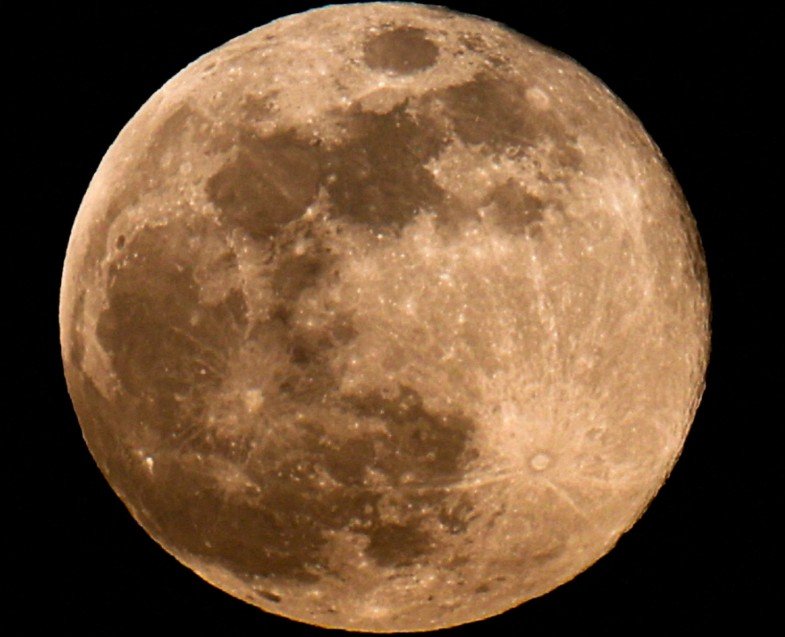
January’s full Moon is traditionally called the Wolf Moon, a name rooted in old folklore tied to winter nights and howling wolves. In 2026, this full Moon also qualified as a supermoon.
A supermoon happens when a full Moon occurs near the Moon’s closest point to Earth, known as perigee. This makes the Moon appear slightly larger and noticeably brighter than a typical full Moon.
On January 3, the Wolf Moon was brighter than usual, becoming the brightest Moon of 2026.
That’s something people could actually see.
The Moon looked fuller, more luminous, and a bit dramatic hanging low in the winter sky. City dwellers noticed it peeking between buildings. Rural areas got a crystal-clear view, weather permitting.
Key things that made this Moon stand out:
-
It was both full and close to Earth.
-
Its brightness increased by roughly 15 percent compared to an average full Moon.
-
Its apparent size grew by about 7 percent, small but visible to careful observers.
That combination gave the night a glow people don’t forget easily.
A Rare Alignment That Felt Bigger Than It Was
What made January 3 feel special wasn’t just the science. It was the timing.
Perihelion happens every year. Supermoons happen several times a year, depending on lunar cycles. But seeing both align on the same date is less common.
The Sun reaching its closest point during the day and the Moon shining at peak fullness at night gave the date a neat symmetry. Day and night both had something astronomical going on.
Still, it’s important to keep expectations realistic.
The Sun didn’t suddenly loom larger in the sky. Earth didn’t heat up. Gravity didn’t go haywire. Planets stayed calm, basically.
What changed was perspective. People looked up. They asked questions. They noticed patterns they usually ignore.
And that, honestly, is half the point of these moments.
Why Events Like This Spark So Much Interest
Celestial events tap into something deeply human. They mix hard numbers with wonder, science with storytelling.
A phrase like “largest Sun of the year” sounds dramatic, even if the difference is measured in fractions of a percent. A “brightest Moon” feels emotional, even if it follows predictable physics.
January 3, 2026, reminded people that Earth is always moving, always shifting its position in space. We just don’t feel it most of the time.
Once in a while, the calendar lines up in a way that makes the motion feel real.