
Georgia Faces its Own Crisis as Political Turmoil Deepens
Tbilisi, Georgia — As 2024 draws to a close, the political crisis in Georgia is intensifying, drawing comparisons to the events of January 6, 2021, in the United States. The former Soviet republic of Georgia, located in the Caucasus region, is witnessing its own battle over democracy, legitimacy, and political power. While the American public has largely moved on from the Capitol riot, the tension in Georgia continues to escalate as its political future hangs in the balance.
The situation stems from the recent presidential election on December 29, 2024. In a move that has divided the nation, Mikheil Kavelashvili, a hardline critic of the West, was elected as the country’s new president. This victory was secured by an electoral college dominated by the ruling Georgian Dream party, which has close ties to Russia. But not everyone is on board with the results. Outgoing President Salome Zourabichvili has rejected Kavelashvili’s legitimacy, drawing a stark parallel to the disputed election aftermath in the U.S.
Georgia’s ‘January 6’: A Political Standoff with Echoes of the U.S. Capitol
While Georgia’s political upheaval may not have involved the violent storming of a Capitol building, the essence of the conflict feels eerily familiar. Zourabichvili, the pro-Western leader who lost the election, is refusing to accept the results. Speaking to her supporters outside the presidential palace, she declared, “I remain the only legitimate president.” The symbolic gesture of leaving the palace while claiming to carry the trust of the people mirrors the defiance seen in American politics when Donald Trump and his supporters disputed the results of the 2020 presidential election.
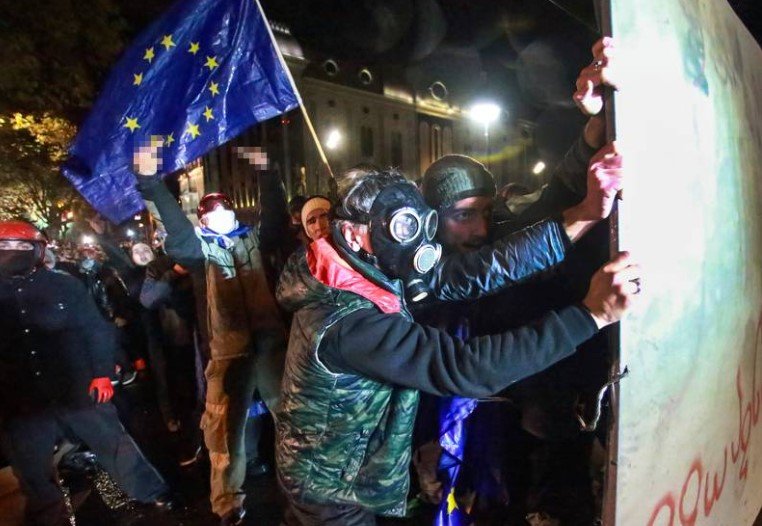
The parallels between the two situations are striking. In both cases, a leader who lost the election refuses to concede, rallying supporters in defiance of the established democratic process. However, unlike the U.S. where the riots turned deadly and led to criminal charges for many participants, the situation in Georgia remains politically charged, with little violence—yet the threat of instability is just as real.
Prime Minister Irakli Kobakhidze of the Georgian Dream party defended the election, emphasizing that Kavelashvili’s presidency would contribute to Georgia’s sovereignty and national unity. However, this has done little to quell the opposition’s concerns.
Kavelashvili’s Presidency: What it Means for Georgia
Kavelashvili’s election represents a sharp shift in Georgia’s political trajectory. A staunch critic of Western influences, Kavelashvili is expected to steer the country closer to Russia, a move that has alarmed many Georgians who favor a pro-European, pro-Western orientation. His anti-Western stance and alignment with the Kremlin are likely to strain relations with the European Union and NATO, two entities that Georgia has aspired to join in recent years.
His election marks a pivotal moment in the ongoing struggle within Georgia between those who want closer ties with the West and those who prefer a relationship with Russia. With a political landscape divided between pro-Western and pro-Russian factions, Kavelashvili’s presidency could bring more polarization and tension, rather than unity, as the Georgian Dream party claims.
Georgians who backed Zourabichvili see the election of Kavelashvili as a step backward, signaling a decline in the country’s democratic ideals and its Western aspirations. The rejection of Kavelashvili’s presidency by the former president is only deepening the divide.
Political Uncertainty: What Comes Next for Georgia?
As Georgia grapples with its political crisis, it’s hard to predict what the future holds. Will Kavelashvili be able to consolidate power and bring stability, or will his presidency be contested by a growing opposition movement? How long will Zourabichvili maintain her stance as the “legitimate” president? Only time will tell.
For now, the political climate in Georgia mirrors the fractured state of American politics in 2021. The echoes of January 6 are loud, though the form they take in Tbilisi is different. Nevertheless, the consequences of these political standoffs—whether in Washington or Tbilisi—are real, with deep impacts on democracy, public trust, and international relations.
