
More than 25 years after Georgia’s five Presbyterian bodies last met together, church leaders gathered on St. Simons Island with a clear challenge. True inclusion means congregations must change, not just invite others to fit in.
That message from the Rev. Jihyun Oh set the tone for a rare statewide gathering that asked hard questions about the future of the church.
Rev. Jihyun Oh Calls for Real Inclusion
At the center of the event was Jihyun Oh, who serves as Stated Clerk of the General Assembly of the Presbyterian Church (U.S.A.) and executive director of the Interim Unified Agency.
Speaking at Epworth by the Sea on St. Simons Island, Oh told attendees that churches often confuse diversity with inclusion.
“Having people present in a room is not the same as having their full personhood incorporated into the life of the body,” she said.
Her address came during the 2026 Georgia Presbyteries’ Gathering, a two day event held Feb. 20 and 21. The conference theme, “Building a Bigger Table: Gathering, Sharing and Learning Together,” reflected a desire to rethink how congregations welcome new members.
The last time all five Georgia presbyteries gathered together was in 1998.
Oh made it clear that hospitality alone is not enough. Churches must be willing to shift their culture, habits and power structures.
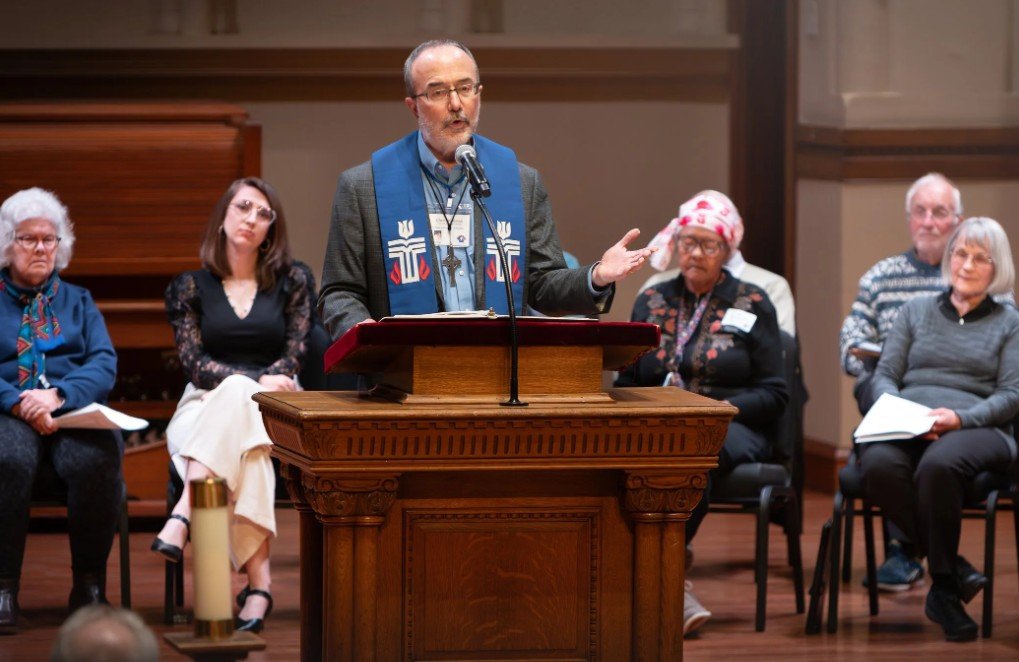
Five Georgia Presbyteries Gather After 28 Years
The gathering brought together Presbyterians from five regional bodies:
-
Cherokee Presbytery
-
Flint River Presbytery
-
Greater Atlanta Presbytery
-
Northeast Georgia Presbytery
-
Savannah Presbytery
Savannah Presbytery has long held annual February leader events, but this marked the first joint statewide meeting in nearly three decades.
Clergy, elders and lay leaders met for worship, workshops and group conversations. The goal was not only fellowship but also reflection on how the denomination can respond to changing communities in Georgia.
Church membership trends have shifted across many mainline Protestant denominations in recent decades. Leaders in attendance acknowledged that demographic change, cultural divides and generational differences are reshaping congregations statewide.
Oh framed her keynote as a collaborative reflection rather than a lecture.
“In undergraduate, I was trained as a scientist,” she told the audience. “I’m bringing ideas for peer review.”
Scripture and Church Constitution Shape the Message
Oh grounded her remarks in both Scripture and church governance.
She referenced the Book of Order section F 1.0404, which calls the church to openness in membership, discernment and institutional forms. That constitutional language, she said, invites congregations to remain open to what God is doing in the world.
“We are to be open to new membership,” Oh said. “We are to be open to what God is doing in the world.”
She paired that foundation with several New Testament passages.
From 2 Corinthians 5, she highlighted the call to see people not from a human point of view but as part of a new creation in Christ.
From Galatians 3, she cited the baptismal vision that erases divisions between Jew and Greek, slave and free, male and female.
From Romans 12, she pointed to the instruction not to conform to the present age but to be transformed by renewing the mind.
Her central argument was simple but challenging.
Inclusion requires transformation of the whole body, not assimilation of the newcomer.
Diversity vs Inclusion: A Key Distinction
Oh used a personal story to explain the difference.
She described a close knit friend group that welcomed a new member but expected that person to adjust to the existing culture. The group did not consider changing itself in response to the new relationship.
“That expectation is precisely what most churches quietly maintain,” she said.
In many congregations, newcomers are invited to join worship, committees or fellowship events. Yet unspoken norms often remain intact, from worship style to decision making patterns.
Oh suggested that real inclusion asks deeper questions.
-
Who makes decisions?
-
Whose voices are heard?
-
Whose traditions shape worship?
-
Who feels fully seen and valued?
Simply increasing representation does not address those structural issues.
She urged church leaders to think about intercultural competence and organizational habits. Congregations, she said, must examine how culture, race, language and generational identity shape their life together.
A Bigger Table for a Changing Georgia
Georgia’s population continues to grow and diversify, particularly in metro Atlanta and coastal regions.
Churches across the state are seeing shifts in racial makeup, age distribution and cultural background. Leaders at the gathering said those changes create both opportunity and tension.
Governor level political debates and national cultural divisions also affect congregational life. Church leaders often navigate differences in theology, social views and community engagement.
Oh did not offer a quick fix.
Instead, she called for renewed imagination.
“To think more expansively about what it means to be church,” she said, “and to have our minds renewed about the way we think about what it means to be the body.”
What Building a Bigger Table Could Mean
| Area | Possible Shift |
|---|---|
| Worship | Incorporate diverse music and language |
| Leadership | Share authority across cultures and generations |
| Decision Making | Broaden participation in discernment |
| Community Outreach | Engage neighborhoods beyond existing networks |
These changes, leaders acknowledged, require patience and humility.
They also require risk.
A bigger table may mean letting go of familiar patterns.
Looking Ahead for PCUSA in Georgia
The statewide gathering ended with worship and conversation rather than resolutions. Organizers said the goal was not to produce policy statements but to spark ongoing dialogue.
For many in attendance, the event marked a rare moment of unity across regional lines.
Oh’s message lingered after the final hymn.
Inclusion, she said, is not a program. It is a spiritual practice rooted in baptism and shaped by grace.
As Georgia congregations return to their local churches, the challenge remains clear. Will they simply invite others to join the existing table, or will they expand it so that everyone reshapes the feast?
The future of the church in a changing state may depend on that answer.
What does building a bigger table look like in your congregation or community? Share your thoughts in the comments and continue the conversation with your church family and neighbors.
