
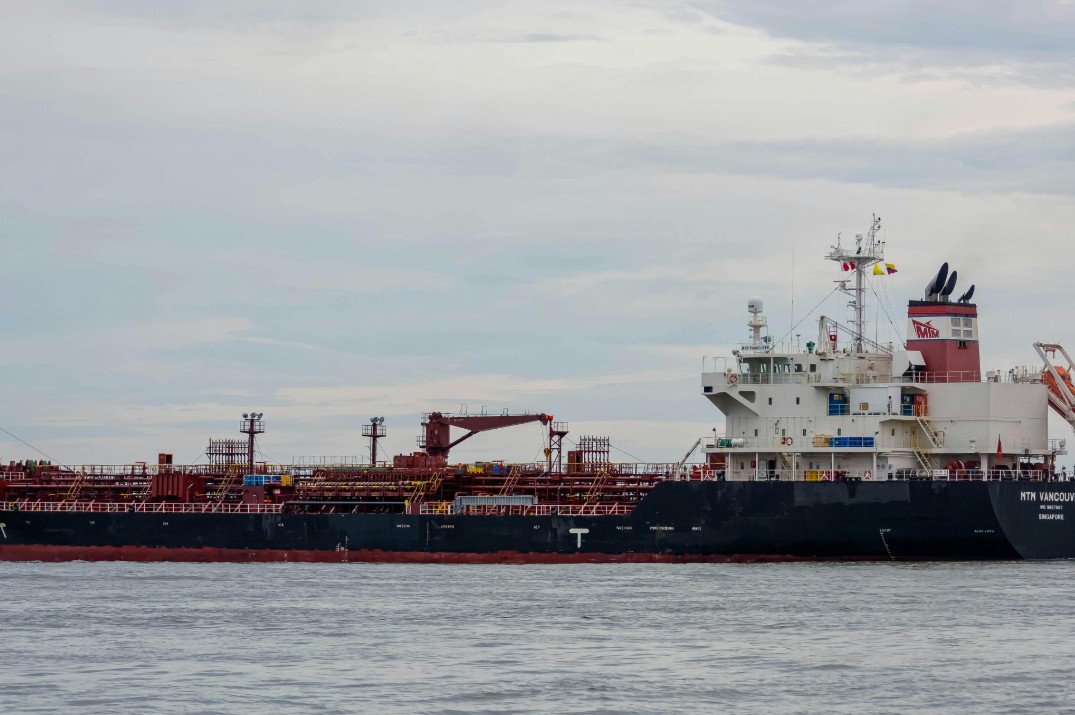
Georgia’s coast guard briefly stopped an oil tanker in the Black Sea after authorities said it breached maritime navigation rules, a small but telling incident unfolding against the backdrop of shifting shipping routes and post-sanctions reflagging practices.
The vessel was fined, released, and sent back on its way. Still, the episode has drawn attention across regional shipping circles.
A short detention, a clear message
The Border Police of Georgia confirmed the detention on January 10, saying the tanker Caminero had violated navigation regulations while transiting Georgia’s territorial waters.
Officials stressed the action was procedural, not punitive beyond the fine.
There was no chase, no standoff, no prolonged inspection.
Just a stop, paperwork, and payment.
Authorities said the Coast Guard acted after detecting irregularities related to how the vessel was operating within controlled waters, an area where compliance is tightly enforced.
In a region as busy as the eastern Black Sea, even minor deviations tend to get noticed.
From Russian registry to Panama flag
The tanker’s background added a layer of quiet intrigue.
According to vessel-tracking data, Caminero had previously sailed under the Russian flag, a registration dating back to 2017.
Before that, records show it had been registered in Malta in 2015.
That changed in November 2022, when the ship was re-registered under the Panamanian flag.
The timing mattered.
That switch came after Western sanctions tightened pressure on Russian oil exports, prompting many operators to move vessels between registries, sometimes more than once.
Shipping experts say flag changes are legal, common, and often dull.
But in the current climate, they rarely go unnoticed.
Fine issued to captain, voyage resumes
Georgia’s Border Police said the ship’s captain, a Turkish citizen, was fined GEL 15,000, roughly $5,600.
The penalty was issued under Georgia’s Code of Administrative Offenses.
The cited provision applies to vessels with a total capacity between 3,000 and 5,000 tons.
Once the fine was paid, authorities cleared the tanker to continue its voyage.
No cargo was seized.
No further sanctions were imposed.
By January 11, vessel-tracking platforms showed the tanker back at sea, moving through the Black Sea as normal.
Business, basically, continued.
Why Georgia watches its waters closely
Georgia sits along a sensitive maritime corridor linking Europe, Russia, Turkey, and Central Asia.
Its territorial waters see constant movement of oil tankers, bulk carriers, and cargo ships heading to and from regional ports.
That traffic has grown more complicated since sanctions reshaped energy flows.
Officials say strict enforcement of navigation rules is less about politics and more about safety and sovereignty.
A small misstep can have large consequences in narrow or heavily monitored waters.
Environmental risk is always part of the calculation.
So is precedent.
Georgia’s Border Police has repeatedly said that all vessels, regardless of flag or origin, are subject to the same checks.
This case, they noted, was no exception.
A wider pattern in post-sanctions shipping
Since 2022, maritime analysts have tracked a noticeable increase in ships changing flags, ownership structures, or operating routes.
Many of these moves sit in legal gray zones.
Others are perfectly lawful but draw scrutiny anyway.
In the Black Sea region, authorities from multiple countries have increased monitoring, especially for tankers with recent re-registrations.
That does not mean every stop signals wrongdoing.
Often, it’s just enforcement doing what enforcement does.
Still, each incident adds another data point to a much larger picture of how global shipping is adjusting, sometimes awkwardly, to new rules and pressures.
