
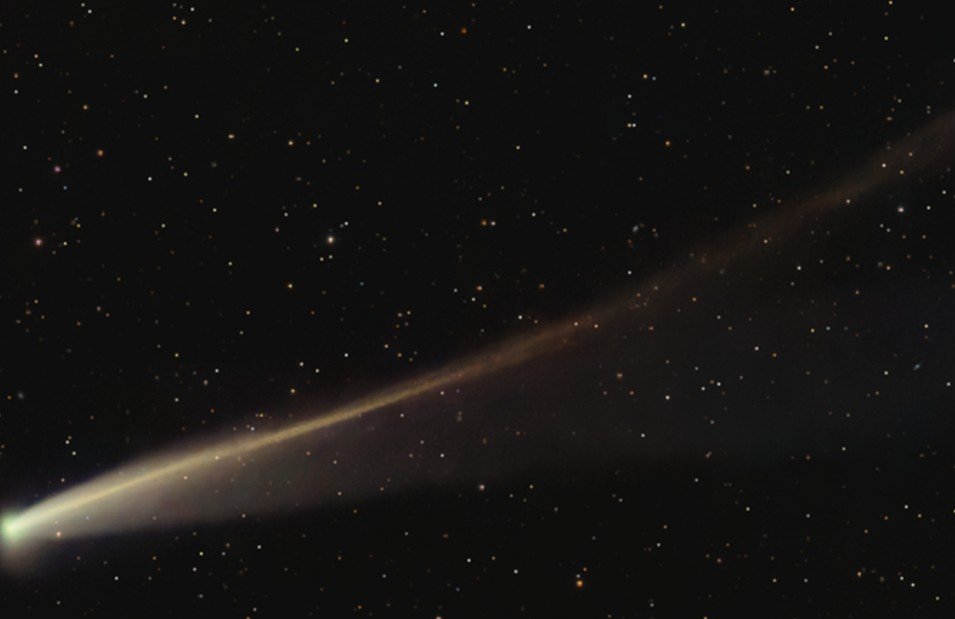
A new comet is quietly building anticipation as 2026 gets underway. Known as C/2025 R3, this icy visitor from deep space could brighten sharply by April, possibly edging into naked-eye territory if sunlight plays along.
For astronomers and casual sky-watchers alike, the excitement sits at the intersection of orbital timing, dust physics, and a visual trick called forward scattering. It’s fascinating stuff, actually.
A Fresh Arrival From the Solar System’s Outer Fringe
C/2025 R3 is not a repeat guest. Its orbital path suggests this comet is making its first known pass through the inner solar system, having drifted in from the distant Oort Cloud.
The comet was first detected on September 8, 2025, by the Pan-STARRS observatory, perched high on the Haleakalā volcano in Hawaii. Follow-up observations by the Canada-France-Hawaii Telescope helped pin down its trajectory.
That trajectory matters.
Its nearly parabolic orbit is a classic sign of a new comet, one that has spent billions of years in deep freeze before being nudged sunward by gravitational disturbances.
For astronomers, these newcomers are unpredictable. Sometimes they fizzle. Sometimes they surprise everyone.
C/2025 R3 still has plenty of mystery baked in.
April Dates That Matter More Than You’d Think
Timing is everything with comets, and April 2026 is shaping up as the key window.
C/2025 R3 will reach perihelion, its closest point to the Sun, on April 20. At that moment, it will be about 76.3 million kilometers from the Sun, placing it well inside the orbits of Mercury and Venus.
Seven days later, on April 27, the comet will make its closest approach to Earth at roughly 70.8 million kilometers.
That’s not dangerously close, obviously, but close enough to improve visibility prospects.
This geometry also means observers in the Northern Hemisphere may get a decent viewing angle in the pre-dawn sky.
By mid-April, astronomers expect the comet to sit around 15 degrees above the eastern horizon about an hour before sunrise.
That’s low, but workable, especially from locations with a clear horizon.
Why Brightness Is Still a Big Question Mark
Here’s the tricky part. Predicting comet brightness is messy, and anyone who says otherwise is overselling it.
C/2025 R3 is expected to brighten significantly as it approaches the Sun, driven by heating that releases gas and dust from its nucleus.
But whether it becomes visible to the naked eye depends on more than distance alone.
The size of its nucleus matters. The amount of dust matters. And how that dust interacts with sunlight really matters.
This is where forward scattering enters the picture.
Without it, the comet may remain a binocular or telescope object. With it, things could get interesting.
Forward Scattering and the Light Trick That Changes Everything
Forward scattering sounds technical, but the idea is fairly intuitive.
When sunlight hits the dust particles in a comet’s tail, some of that light gets scattered. If the geometry is right, much of that scattered light is directed straight toward Earth.
That alignment can cause the comet to appear much brighter than models initially predict.
This typically happens when a comet passes between Earth and the Sun, placing the dust tail in a position that favors this effect.
C/2025 R3 may pass through such a configuration in April.
If that happens, brightness could jump sharply over a short period.
Past comets have pulled off similar surprises, suddenly glowing far above expectations just days before or after perihelion.
It’s a bit of a cosmic gamble, honestly.
The Role of the Moon and Darker Skies
As if comet watching weren’t complicated enough, the Moon always gets a say.
In this case, timing works in observers’ favor.
A new Moon will occur on April 17, 2026, just three days before C/2025 R3 reaches perihelion.
That means darker skies during a critical phase of the comet’s approach.
With minimal moonlight, faint objects stand out better, especially during the narrow pre-dawn window when the comet is expected to be visible.
For Northern Hemisphere observers, this could make the difference between spotting a faint smudge and missing it entirely.
Southern Hemisphere visibility will be more limited, though not impossible.
How C/2025 R3 Fits Into a Busy Era for Comets
The past few years have been surprisingly generous to comet watchers.
Observers still remember the dramatic flares of 12P/Pons-Brooks, sometimes called the Devil Comet, and the appearances of C/2024 G3 (ATLAS). In 2025, C/2025 A6, often referred to as Lemmon, and C/2025 R2 (SWAN) kept telescopes busy.
There was also C/2025 K1 (ATLAS), which fragmented and raised the possibility of becoming a headless comet.
Against that backdrop, C/2025 R3 feels like the next chapter rather than an isolated event.
Still, each comet plays by its own rules.
Some fade quietly. Others put on a show no one saw coming.
What Astronomers Will Be Watching Closely
As April approaches, professional and amateur astronomers will monitor several key indicators:
-
Changes in the comet’s gas and dust production rates
-
Sudden outbursts or fragmentation events
-
Early signs of enhanced forward scattering
Any of these could alter brightness forecasts in a matter of days.
That uncertainty is part of the appeal. Comets refuse to be boring.
C/2025 R3, especially as a first-time visitor, has plenty of room to surprise.
