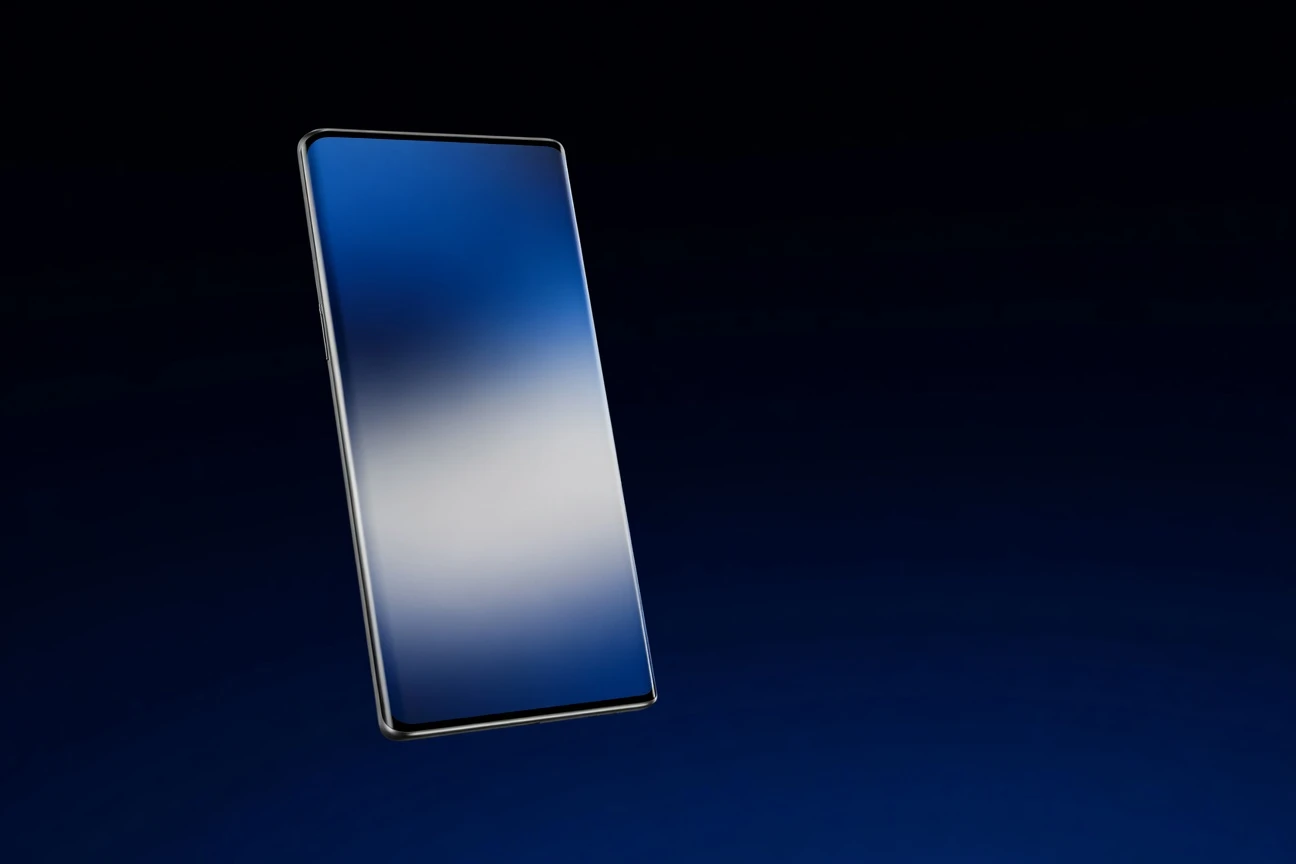
Apple’s iPhone 19 Pro and iPhone 19 Pro Max are already in evaluation-stage testing with quad-curved OLED (organic light-emitting diode) displays, with hardware prototypes on the bench roughly 16 months before a projected fall 2027 launch. The information comes from Digital Chat Station, a Weibo leaker with more than three million followers, whose disclosure this week corroborates a separate supply-chain report from April. No prior iPhone has used a display that curves downward on all four edges simultaneously.
The bolder ambition sitting behind those prototypes is a completely uninterrupted front face, with biometric sensors and the selfie camera both hidden beneath the panel and no visible cutouts at all. Display analyst Ross Young of Display Supply Chain Consultants has said that target may not be achievable for a 2027 release. Whether the engineering closes in time separates two very different outcomes for Apple’s most significant anniversary since the iPhone X.
Prototypes in the Wild, Already
In Apple’s production calendar, evaluation-stage testing is the phase where component decisions are being validated against the final form factor. Hardware at this point is not a laboratory sketch; it reflects Apple’s active manufacturing direction, with major decisions still reversible but narrowing fast. Digital Chat Station’s description of the current prototype specifies a hole-punch cutout for the front-facing camera, with the Face ID module shifted under the display panel. That configuration suggests Apple has made more progress on the harder biometric-concealment challenge than on the camera concealment problem.
The leaker’s credibility on Apple hardware is grounded in a verifiable track record. Digital Chat Station accurately predicted the iPhone 17 Pro’s triple 48-megapixel rear camera setup before Apple confirmed it, correctly described the overall design of the iPhone Air ahead of its debut, and recently said Apple’s first foldable, expected alongside the iPhone 18 Pro this fall, will be marketed as “iPhone Ultra.” Supply-chain followers grade sources against their history, and this account consistently ranks near the top of that informal list for Apple-specific hardware claims.
An April 2026 version of the same curved-display claim included a specific supply detail: Digital Chat Station identified Samsung Display as the vendor producing the “four-micro-curve” OLED panel for the 2027 Pro lineup. Korean trade reporting from September 2025 had separately flagged Samsung Display as already working on the relevant panel technology. Two independent signals, pointing to the same supplier and the same screen geometry and separated by roughly six months, give the current evaluation-stage update its structural weight.
The final product name remains unresolved. The leaker uses “iPhone 19 Pro” as a working label, but Apple may skip that number to land on “iPhone 20” as a direct acknowledgment of the 20th anniversary, echoing the 2017 decision to skip “iPhone 9” and announce iPhone X. Market research firm Omdia has suggested the naming skip is under active consideration. “iPhone XX,” a simplified return to just “iPhone,” and other variants have circulated in reporting without confirmation from Apple on any of them.
The Panel Behind the Design
The display technology powering those prototypes has firmer supply-chain backing than most of the surrounding design details. Apple has reportedly engaged Samsung Display, whose official technology portfolio lists COE as a key OLED advancement, to produce the quad-curved screen. COE, or Color Filter on Encapsulation, is a construction method that places the color filter layer directly onto the panel’s encapsulation layer rather than a separate polarizing substrate. Eliminating that polarizing film is what drives the brightness and efficiency gains that multiple independent sources have now cited.
Leaker Ice Universe, active on both Weibo and X, has suggested Apple may market the result as a “Liquid Glass Display,” language that connects the hardware to Apple’s recent software interface design direction. That branding is unconfirmed and treated in well-sourced coverage as a plausible guess about marketing rather than confirmed nomenclature. The COE substrate, Samsung Display’s sole-source role, and the shallow curvature geometry have each been reported from multiple independent sources with supply-chain access.
- ~30% improvement in panel brightness versus conventional OLED, enabled by removing the polarizing film layer through the COE method
- ~25% reduction in power draw from the same structural change to the panel stack
- 2021: Samsung first commercialized COE in the Galaxy Z Fold 3; broader flagship deployment arrived with the Galaxy S26 Ultra this year
It is not a traditional quad-curved display, nor is it anything like the curved screen solutions we have seen on Android phones over the years. The curvature itself could be extremely subtle.
Ice Universe posted that characterization on X in late April, drawing a deliberate line between Apple’s target and the waterfall screens that dominated premium Android hardware around 2020. Apple reportedly wants cover glass that arcs gently at all four edges while the active OLED surface below stays flat at center, similar to how Apple Watch glass flows over the frame without the display pixels following it. Korean component publication TheElec confirmed in late 2024 that Apple specifically does not want the curved-edge portions to carry active display area. The curve is an optical and ergonomic feature, not an extended screen surface.
Twenty Years in the Making
The iPhone X in 2017 was the last time Apple used a major anniversary to force a complete design reset. It moved the iPhone from LCD to OLED, removed the home button, introduced Face ID, and established the visual template that every Pro model through the iPhone 17 Pro has extended. Apple is now building toward an equivalent pivot a decade later, with Samsung Display in the same exclusive supply role and the same structural incentive to price the panel accordingly.
| Factor | iPhone X (10th anniversary, 2017) | iPhone 19 Pro or iPhone 20 (20th anniversary, 2027) |
|---|---|---|
| Display shift | LCD to flexible OLED, first iPhone OLED | Flat OLED to quad-curved COE OLED |
| Panel supplier | Samsung Display, sole source | Samsung Display, sole source per supply-chain reporting |
| Authentication change | Touch ID removed; Face ID introduced above the display | Face ID targeted for full concealment beneath the display panel |
| Estimated panel cost premium | Approx. $110 to $120 per module versus the prior LCD panel | Not yet publicly reported |
| Projected design legacy | Set the Pro visual template through at least iPhone 17 Pro | Analyst Jeff Pu projects it sets the 2027 Pro template going forward |
Samsung Display charged an estimated $110 to $120 per iPhone X module in 2017, roughly double the cost of the LCD it replaced. No equivalent figure has surfaced for the 2027 COE panel, but a curved substrate, the COE manufacturing process, and sole-source supply from one vendor recreates the same structural leverage Samsung held in 2017. Whether Apple absorbs that premium in margin or passes part of it to buyers in launch pricing is a question the bill-of-materials process, expected to lock in late 2026, will eventually answer.
Android’s Inevitable U-Turn
Curved displays have already run one complete market cycle in Android hardware, and Apple’s 2027 move is set to start a second. Samsung introduced edge curvature to mass-market smartphones with the Galaxy Note Edge in October 2014, a device that curved on one side. By 2020, dual-curved and waterfall panels from Huawei, OnePlus, Motorola, and Xiaomi had become the default across high-end Android devices. Then the trend reversed sharply. Chinese and Korean brands shifted to flat-edge designs from roughly 2021 onward, in large part because Apple’s flat-sided iPhone aesthetic had become the aspirational reference in the premium segment. Curved glass went from premium signal to dated look within a single product generation.
Apple picking up the form those brands abandoned reverses the dynamic. When Apple shifts a design at Pro scale, display supply chains recalibrate around the new geometry and competitors targeting the same buyers typically follow within two product cycles. Several Android devices already offer quad-curved panels as niche options ahead of Apple’s entry:
- Huawei P40 Pro introduced one of the first widely reviewed four-edge curved OLED displays, branding it a “Quad-Curve Overflow Display”
- Xiaomi Mi 11 adopted four-edge curvature across several flagship models before the broader trend reversed industry-wide
- OnePlus 13 returned to a quad-curved panel in a modern shallower form, described in reviews as a revival of 2.5D glass ergonomics
- Motorola Edge 60 Pro launched in 2025 with a quad-curved screen, joining a modest pre-Apple revival of the format
None of those devices moved the market. An Apple Pro launch reaching tens of millions of buyers in fall 2027 carries a different weight, and Android brands that spent several years imitating flat iPhone aesthetics will be mapping quad-curved flagships for the cycles that follow.
The Engineering Gate
Under-Display Authentication, the More Solvable Problem
Apple’s Face ID array uses a flood illuminator, an infrared camera, and a dot projector to build a three-dimensional map of the user’s face for authentication. Placing those components beneath a display panel introduces optical interference: OLED pixels scatter infrared light before it reaches the sensors, degrading both the flood-illumination spread and the accuracy of the dot projection. Achieving biometric reliability from behind a panel is demanding, but it has a key advantage over photography. Authentication systems send their own controlled light source and read the return signal, making them less sensitive to ambient color shifts and contrast distortion than a camera optimized for natural-scene imaging.
The leaker-versus-analyst split on this question has not converged. The leaker’s prototype description treats facial recognition concealment under the panel as part of the current evaluation hardware, implying it is at minimum being actively tested at this stage. Ross Young of Display Supply Chain Consultants has said in published commentary that a fully cutout-free iPhone will not arrive until 2030, placing under-display facial recognition outside the 2027 window. The hole-punch prototype, with the biometric module hidden but the selfie-camera cutout retained, may be the middle path both sides are converging on from different vantage points.
The Selfie Camera, a Harder Ask
A front camera has no equivalent advantage against the display-interference problem. Where a biometric sensor emits its own controlled light and reads the return, a camera must capture ambient light traveling downward through a panel filled with emissive pixels. Each pixel absorbs and scatters incoming photons, reducing color accuracy, degrading contrast, and generating flare that computational photography can address only partially. The Samsung Galaxy Z Fold 6 and other Android foldables with under-display selfie cameras consistently receive reviewer criticism for softness and ghosting that conventional front cameras avoid. The underlying physics of shooting through an active OLED surface sets a quality ceiling that current implementations have not cleared to Apple’s standards.
The COE construction Apple is pursuing may help marginally. Removing the polarizing film lets more light travel through the stack in both directions, improving transmission for an under-panel camera relative to a conventional OLED. Supply-chain reporting has described the selfie camera as the harder of the two concealment challenges for 2027. If the front camera cannot meet Apple’s quality floor, the anniversary iPhone ships with a hole-punch cutout for photography while the authentication array sits invisibly beneath the glass, eliminating the Dynamic Island entirely but stopping short of the continuous front face Apple wants.
One Model or Two
The question of whether the quad-curved design applies to one model or several has shifted multiple times and remains open. Earlier reports framed the design as a standalone commemorative device sitting above the Pro tier, a one-cycle premium edition sold alongside conventional models. Analyst Jeff Pu of GF Securities pushed back in a note cited by industry publications, arguing the 20th-anniversary design is intended for Apple’s standard Pro and Pro Max lineup, not a separate device positioned above it. Under Pu’s reading, the quad-curved panel becomes the new normal for the 2027 Pro tier, with no distinct commemorative model on top.
That single-product reading is complicated by the current leak. If Apple’s 2027 Pro carries a visible hole-punch cutout while a separately described anniversary device targets no cutouts at all, some design distinction between the two must exist in Apple’s current planning. Whether that gap produces a separate higher-tier model, a staggered release schedule, or a contingency that activates only if the selfie camera engineering clears in time, the available reporting cannot settle. Apple internally refers to the device as V72, per a roadmap published by The Information, with a fall 2027 target still intact.
Building toward that moment, the iPhone 18 Pro is expected this fall as the intermediate step, projected to shrink the Dynamic Island significantly before 2027 targets the display geometry more aggressively. The iPhone 18 Pro launch picture covering the A20 chip, India pricing strategy, and camera hardware upgrades shows how Apple is setting up the 2026 cycle before the bigger reset. Whether fall 2027 delivers a clean glass slab or a curved-edge phone with one visible camera hole, the selfie-camera question is the only variable Apple cannot control through supplier negotiation or panel engineering alone. It will be answered on a production line sometime in the next 12 months, and the answer determines whether the 20th anniversary arrives complete or deferred by one generation.