The CTR, a boutique food hall carved from the former CNN Center’s 14-story atrium in downtown Atlanta, opened on May 20, 2026, with 11 chef-driven stalls and what developers call Georgia’s largest bar. Curated by Robert Montwaid, the operator behind New York’s Gansevoort Market and Atlanta’s Chattahoochee Food Works, the hall is the first public face of a $65 million renovation of a building that has held four different identities in 50 years.
The room has been a 1976 psychedelic indoor theme park, a decade of vacancy, a 37-year cable news headquarters, and now this: handmade pasta, Puerto Rican mofongo, and a 3,000-square-foot cocktail bar in the atrium where Ted Turner once ran 24-hour global news.
A Room That Reinvents Itself Every Few Decades
Developer Tom Cousins opened the Omni International Complex in January 1976 at a cost of roughly $80 million, combining two office towers, a luxury hotel, an ice rink, and the soaring central atrium. The crown was The World of Sid and Marty Krofft, billed as the country’s first indoor amusement park: a crystal-unicorn carousel, a giant pinball dark ride, and a puppet Elton John lowered from the ceiling on cue. Built to accommodate 6,000 visitors a day, the park drew an estimated 300,000 total guests before closing in November 1976, fewer than six months after opening.
Downtown Atlanta’s reputation for urban decay, ticket prices critics called steep for a two-hour experience, and the proximity of the far-larger Six Flags Over Georgia all contributed to the park’s quick collapse. The space sat largely hollow for a decade, cycling through a brief dinner theater before Ted Turner, searching for room to expand his Cable News Network beyond its cramped Midtown quarters, discovered that the Krofft park’s enormous rooms were nearly purpose-built for broadcast studios and newsrooms. CNN moved into the building in 1987 and stayed for nearly 37 years, drawing up to 300,000 visitors annually through studio tours before the pandemic suspended them. The final CNN domestic programs moved out in February 2024, leaving roughly 900,000 square feet mostly vacant.
CP Group, which acquired the property in 2021 and rebranded it as The Center Atlanta in April 2024, is betting on the food hall as the first public step in a much larger reconstruction. The four chapters of the building’s life break down as follows:
- May to November 1976: The World of Sid and Marty Krofft operates as the country’s first indoor theme park; it closes within six months, drawing an estimated 300,000 total visitors against a design capacity of 6,000 per day.
- 1976 to 1987: The atrium sits largely empty, cycling through a brief dinner theater before that enterprise folds as well.
- 1987 to 2024: CNN Center operates as the global headquarters of the Cable News Network, drawing up to 300,000 visitors annually through studio tours; the last CNN domestic programs move out in February 2024.
- May 2026: CTR Food Works opens on May 20, with a public grand opening set for June 12, three weeks before Atlanta’s first FIFA (Fédération Internationale de Football Association, the international soccer governing body) World Cup matches begin at nearby Mercedes-Benz Stadium.
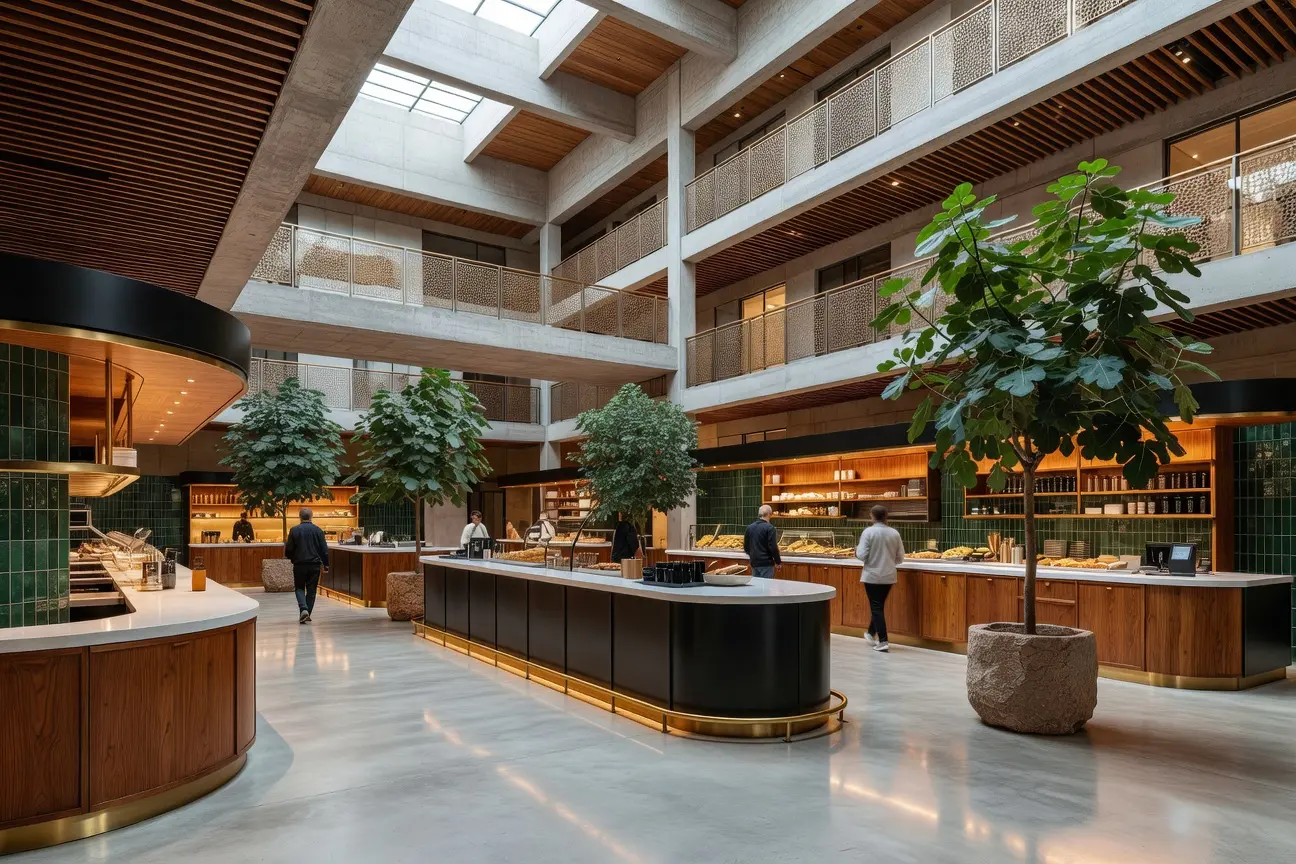
The $65 Million Overhaul and the Atrium’s New Shape
CP Group has pushed $65 million into the property since CNN’s departure: $50 million in exterior renovations, including the installation of giant ATL letters replacing the red CNN sign at the Marietta Street corner, and $15 million into the atrium itself. The food hall, called CTR Food Works, occupies 24,000 square feet of a total CTR footprint of roughly 80,000 square feet. Five separate entrances reinforce its role as a connector between Centennial Olympic Park, State Farm Arena, the adjacent Omni Hotel, and the Georgia World Congress Center one block away.
Inside, seating for roughly 500 guests spreads across banquettes, standard tables, and high-tops on polished floors. Stalls finish in quartz, marble, tile, and wood. Large trees in stone planters stand in the central area, softening the vertical scale of the room without fighting its architecture.
Montwaid describes the CTR as a