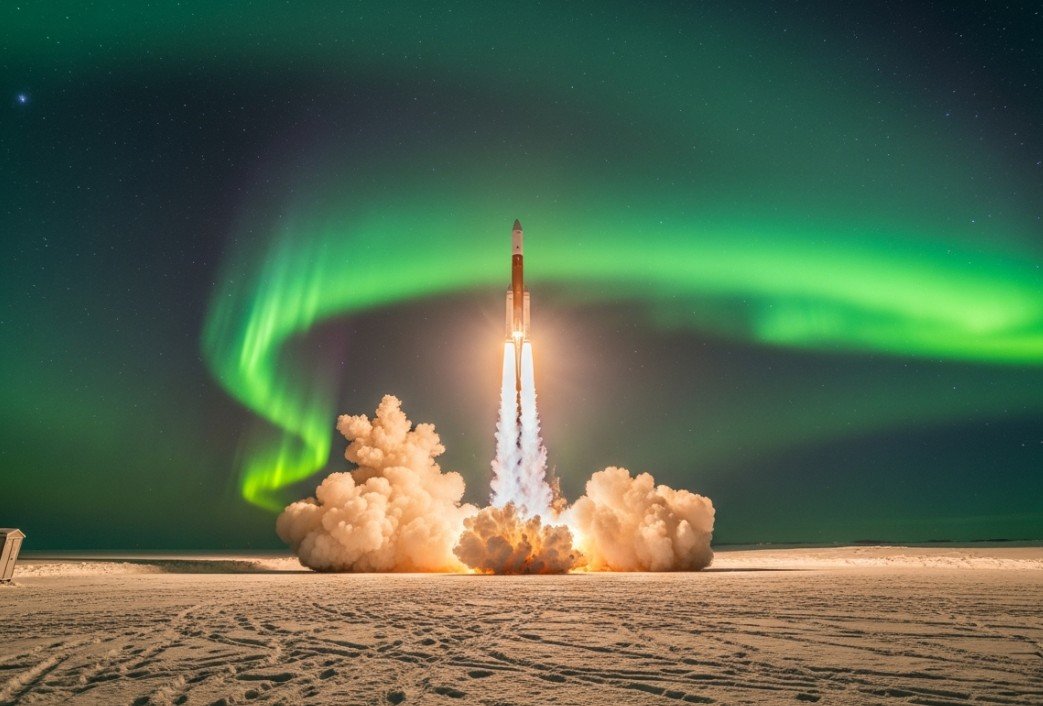
In a bold scientific push to uncover the hidden workings of Earth’s most iconic sky show, NASA is preparing to launch a groundbreaking rocket mission into the Northern Lights that will effectively perform a “CT scan” of the aurora. This mission, set to take place early in 2026 from Alaska, aims to map the electric currents beneath the shimmering auroras and boost our understanding of space weather and its impact on technology here on Earth.
The Northern Lights have long captivated humanity with their beauty. But now scientists are focusing on the powerful physics beneath that beauty and deploying rockets to unlock secrets invisible to ordinary observers.
Why NASA Is Studying the Aurora With Rockets
The aurora borealis, or Northern Lights, are a light show caused when charged particles from the Sun slam into Earth’s upper atmosphere. As these particles collide with gases high above the poles, they create dazzling bands of green, purple, and red light that dance across the night sky. These phenomena, however beautiful, are just the visible sign of a vast electrical circuit linking Earth to space.
The GNEISS mission (Geophysical Non‑Equilibrium Ionospheric System Science) will use two sounding rockets launched simultaneously through an aurora to take measurements from multiple angles. These rockets will deploy subpayloads that collect data on the plasma environment and how electric currents flow through that region.
By comparing how radio signals transmitted through the plasma are altered, scientists can reconstruct a three‑dimensional picture of the charged particle flows under the auroral lights. This technique is compared to how medical CT scans use X‑rays from different angles to build a full internal image of the human body.
NASA explains that the auroral currents are like electricity in a circuit: particles move in and out along magnetic field lines, but tracking exactly how the entire loop closes has been difficult. The GNEISS mission will offer new insights into this complex electric circuitry.
What the Mission Hopes to Reveal
Scientists know quite a bit about where electrons enter the atmosphere to form the aurora, but how the return currents spread and dissipate is still poorly understood. This “closure” of the circuit is where many of the most intriguing mysteries lie.
With the rockets flying side by side, each carrying multiple sensors, researchers will gather electrical and plasma data in different slices of the auroral zone. These measurements will be combined with signals received on the ground to model the currents in three dimensions.
Understanding these currents does more than satisfy scientific curiosity. They are a key part of space weather systems that can heat the upper atmosphere and affect satellite trajectories and communication systems. When the atmosphere warms due to auroral energy, it becomes denser, and satellites can slow or drift. Knowing more about these processes improves predictions that protect space infrastructure and GPS systems.
In the same launch window as the GNEISS mission, NASA also plans to fly the Black and Diffuse Aurora Science Surveyor mission, which will seek to understand odd blank spots inside auroras known as “black auroras” where electric currents may behave unexpectedly.
What Sounding Rockets Do and Why They Matter
Sounding rockets are smaller, suborbital rockets used specifically for targeted scientific research in regions of Earth’s space environment that satellites and ground instruments cannot easily access. They carry instruments briefly into the upper atmosphere and then fall back to Earth, providing data during the peak of auroral activity.
For decades these rockets have been part of NASA’s toolkit for studying space weather. They are valuable because they allow scientists to take instruments directly into the zones of interest rather than inferring conditions from afar. This has led to unique insights into the aurora and related phenomena.
Previous campaigns launched rockets to investigate how auroras affect atmospheric chemistry, such as how aurora‑produced gases like nitric oxide travel down and interact with lower atmospheric layers. These missions have helped scientists refine models of both atmospheric and space weather interactions.
The Science Behind Aurora and Space Weather
Auroras occur at the interface between Earth’s magnetic field and energetic particles from the Sun. Charged particles travel along magnetic field lines, crashing into atoms high above the poles and energising them so they emit the glowing light we see from the ground.
Yet the aurora’s underlying electrical system functions on a much larger scale than the light show suggests. Powerful currents called electrojets can punch millions of amps around the poles. These currents create magnetic disturbances that can ripple down to Earth’s surface, occasionally affecting electrical grids and communication lines. Missions like NASA’s upcoming EZIE mission, using CubeSats to map these currents from orbit, complement rocket studies.
A deeper understanding of how electric currents rise, spread, and close in the high atmosphere improves models of the Earth–Sun connection, part of the broader field of heliophysics. This field studies how solar activity influences planetary environments and technology on the ground.
Challenges and Timing of the Rocket Launch
Auroral conditions and launch windows must align perfectly for such missions to succeed. Scientist teams monitor space weather forecasts and ground‑based cameras to predict the best timing to launch the rockets through active aurora. Because it can take several minutes for rockets to reach the desired altitude, teams predict where the aurora will be rather than where it is at launch time.
Working in Alaska’s night sky during winter months, the scientific teams combine experience with real‑time data to choose launch moments that maximise the science return.
What This Means for Earth and Beyond
Understanding auroras isn’t just an academic pursuit. Scientists have found that intense space weather events can disrupt critical systems such as GPS navigation, satellite communications, and even terrestrial power grids. Improved space weather forecasting helps engineers design better‑protected satellites and alerts industries to potential disruptions.
The insights from the GNEISS mission could also help researchers better understand how energy from the sun flows through near‑Earth space and into the atmosphere. This knowledge feeds into broader models that affect everything from climate studies to protecting astronauts in orbit.
As the rockets prepare to fly into the breathtaking auroras visible from the Arctic sky, scientists and sky watchers alike are poised to learn more about one of nature’s most beautiful and mysterious displays. Let us know how captivated you are by the Northern Lights and what discoveries excite you most. Share your views in the comments and use hashtag #AuroraScanMission to join the discussion.