Georgia health officials have confirmed the state’s first measles case of 2026, involving an infant in the Coastal Health District who contracted the virus during international travel. The case has triggered contact tracing across several counties as public health teams work to contain any possible spread.
The child was too young to receive routine measles vaccination, according to state officials, a detail that has sharpened concern among health authorities early in the year.
An infant case tied to travel outside the United States
The Georgia Department of Public Health confirmed the case on January 12, saying the baby lives in the Coastal Health District, which includes Bryan, Camden, Chatham, Effingham, Glynn, Liberty, Long, and McIntosh counties.
Health officials said the infant acquired the virus while traveling internationally with family.
That distinction matters. Measles remains common in several regions outside the U.S., and imported cases are the most frequent source of infections in states where routine vaccination coverage remains high.
A DPH representative also confirmed the child did not pass through any Georgia airports while infectious.
Still, the agency is identifying people who may have been exposed through close contact in homes, medical settings, or other indoor spaces.
This is the first measles case reported in Georgia in 2026.
Why measles still alarms public health teams
Once declared eliminated in the United States in 2000, measles has slowly reappeared in pockets over the past decade. The virus spreads easily, and even brief exposure can be enough.
Measles moves through the air when an infected person coughs or sneezes.
The virus can linger for up to two hours in the air or on surfaces after an infected person leaves a room. That makes exposure possible even without face-to-face contact, which, frankly, catches many people off guard.
Public health officials say this airborne behavior is what makes measles different from many other childhood illnesses.
And why one case, even a single one, sets off alarms.
Symptoms often arrive quietly before the rash appears
Measles symptoms typically develop seven to 14 days after exposure. Early signs often resemble a bad cold, which can delay recognition.
People usually experience a high fever, cough, runny nose, and watery eyes.
Then comes the rash.
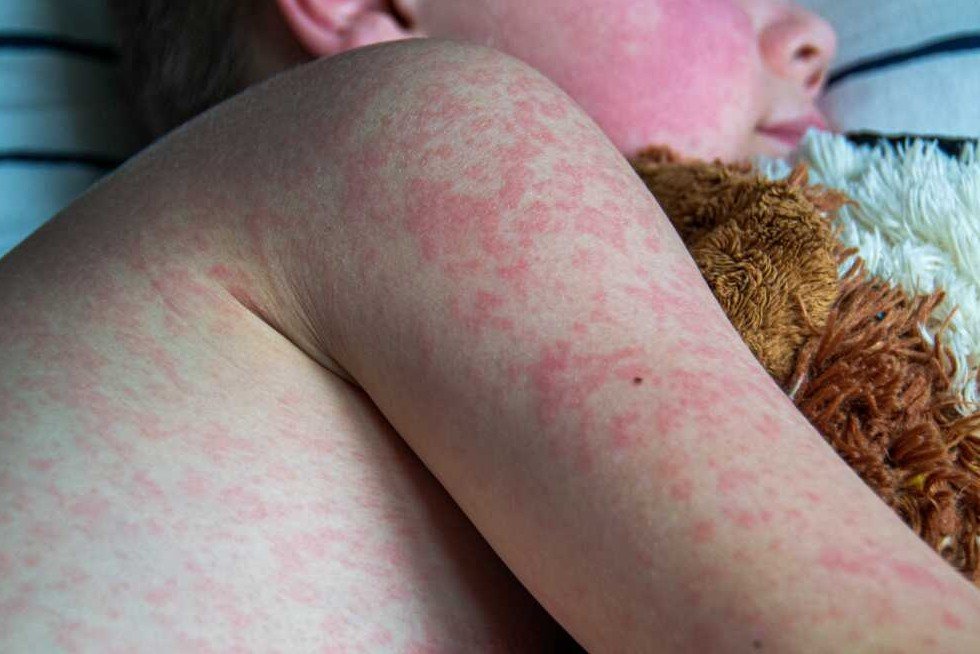
It starts as small red spots at the head and spreads down the body over several days. By the time the rash appears, a person may already have exposed others.
For infants, pregnant people, and those with weakened immune systems, measles can lead to serious complications, including pneumonia and hospitalization.
Vaccination guidance and why timing is everything
The measles, mumps, and rubella vaccine, commonly called MMR, remains the most effective way to prevent infection.
The Centers for Disease Control and Prevention recommends that children receive their first MMR dose between 12 and 15 months of age. A second dose follows between ages four and six.
For babies aged six to 11 months who are traveling internationally, the CDC advises a single early dose before travel.
That early dose does not replace the routine schedule. Two additional doses are still required after the child’s first birthday.
According to state and federal data, more than 95 percent of people develop immunity after one dose of MMR. A second dose raises protection to about 98 percent.
Vaccination also protects others, especially infants who are too young to be vaccinated and people who cannot receive vaccines for medical reasons.
That shared protection, you know, is often invisible but essential.
What officials want the public to do right now
Health authorities are urging calm but awareness, particularly in the Coastal Health District.
People who develop symptoms consistent with measles are asked to contact their healthcare provider immediately.
Officials stress one thing clearly: do not show up at a doctor’s office, hospital, or clinic without calling ahead.
Unannounced visits risk exposing others, including newborns and medically vulnerable patients.
Healthcare providers who suspect measles are required to notify public health officials immediately so isolation and tracing can begin.
This early coordination is critical.
Georgia’s recent measles numbers put the case in context
Georgia recorded 10 confirmed measles cases in 2025.
Those cases were scattered and did not escalate into widespread outbreaks, according to public health records.
Still, national data show measles cases in the U.S. this year have already surpassed totals seen in some earlier years, including all of 2018, according to federal reporting.
Health officials say increased global travel, uneven vaccination rates in some communities, and lingering pandemic-era disruptions to routine care all play a role.
Basically, measles takes advantage of gaps.
How exposure risk is assessed in cases like this
Public health teams look closely at where an infected person spent time during the contagious period.
That includes homes, medical offices, childcare settings, and any enclosed public spaces.
In this case, officials say the child’s movements were limited, which may reduce exposure risk.
Still, the work continues.
Contact tracing can involve dozens of phone calls, timeline reviews, and coordination with healthcare providers across counties.
It is quiet work. But it matters.
A snapshot of key measles facts for Georgia residents
To keep things clear, health officials point to a few established facts:
| Topic | Details |
|---|---|
| Transmission | Airborne, spreads through coughs and sneezes |
| Virus persistence | Up to 2 hours in air or on surfaces |
| Symptom onset | 7–14 days after exposure |
| Georgia cases in 2026 | First confirmed case |
| Georgia cases in 2025 | 10 confirmed |
| Vaccine effectiveness | ~95% after one dose, ~98% after two |
These figures come from state and federal public health data and have remained consistent for years.
Why one case still matters
A single measles case does not mean an outbreak is underway.
Health officials emphasize that point repeatedly.
But measles spreads fast when conditions allow it. Early detection and isolation make a difference, especially in communities with young children.
This case serves as a reminder that global health trends do not stop at state lines.