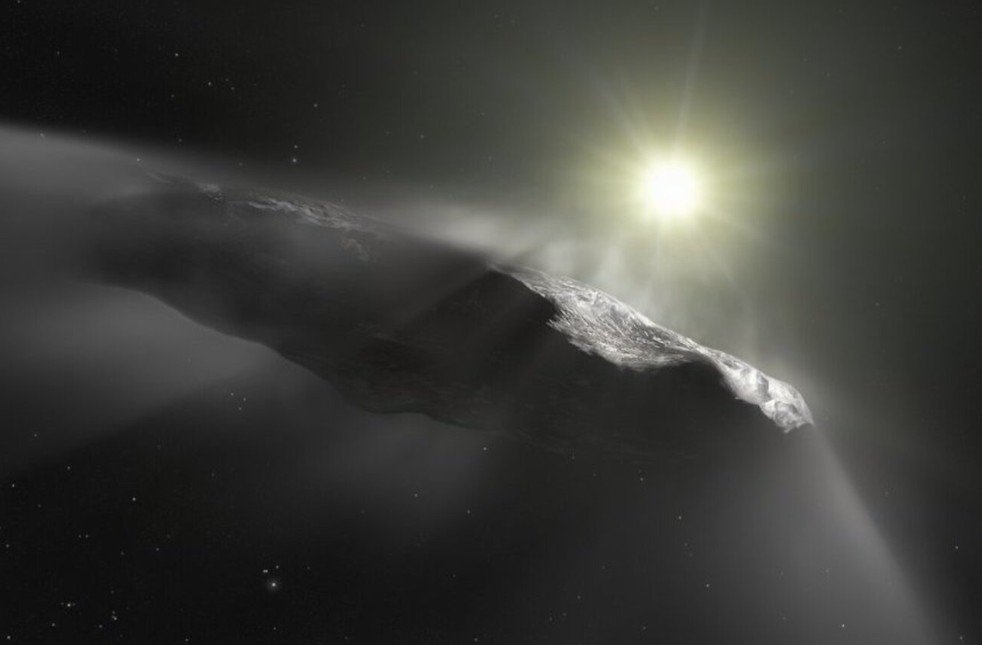
Scientists have detected extraordinarily high levels of methanol and hydrogen cyanide in 3I/ATLAS, only the third confirmed interstellar comet ever observed in our solar system. The findings, revealed through observations with the Atacama Large Millimeter/submillimeter Array (ALMA) in Chile, mark the first time methanol has been identified in an object that originated far beyond our stellar neighborhood.
Third Visitor from Deep Space
Discovered in 2024 and officially designated 3I/ATLAS, the comet is currently speeding through the inner solar system after traveling between stars for possibly hundreds of millions of years. Unlike the first interstellar object 1I/’Oumuamua, which showed no activity, and 2I/Borisov, which released large amounts of carbon monoxide, 3I/ATLAS began outgassing while still extremely far from the Sun, indicating it has experienced very little stellar heating since leaving its birth system.
Unusually Carbon-Rich Chemistry
The ALMA observations, led by Martin Cordiner at NASA’s Goddard Space Flight Center, show 3I/ATLAS is releasing methanol at rates never seen before in any comet, along with substantial hydrogen cyanide close to its nucleus.
Key production rates measured near the nucleus:
• Hydrogen cyanide: 250 to 500 grams per second
• Methanol: Significantly higher than hydrogen cyanide, exceeding levels typical in solar system comets by orders of magnitude
• Carbon dioxide: Also elevated compared to most comets born in our system
These molecules normally appear only in trace amounts in comets that formed around our Sun. Their abundance in 3I/ATLAS suggests it formed in a much colder, carbon-rich environment than any known solar system object.
Comparison with Previous Interstellar Objects
| Object | Origin | Detected Molecules | Notable Feature |
|---|---|---|---|
| 1I/’Oumuamua | Interstellar | None (no coma) | Rocky, no outgassing |
| 2I/Borisov | Interstellar | CO, HCN, water | Extremely CO-rich |
| 3I/ATLAS | Interstellar | CH3OH (methanol), HCN, CO2, water | Highest methanol ever recorded |
Why Methanol and Hydrogen Cyanide Matter
Both molecules play crucial roles in prebiotic chemistry. Methanol is a precursor to more complex organic compounds, while hydrogen cyanide is a building block for amino acids and nucleobases. Finding them together in such abundance offers the strongest evidence yet that the chemical seeds of life are common throughout the galaxy and can survive long journeys between stars.
What Comes Next
3I/ATLAS will reach perihelion in late 2025 or early 2026, depending on final orbital calculations. Astronomers worldwide are scheduling additional observations with JWST, Hubble, and ground-based telescopes to track how its chemistry evolves as it warms. These upcoming data could reveal whether even more complex molecules are present in its coma.
The discovery reinforces the growing view that interstellar objects serve as cosmic messengers, carrying pristine material from distant star systems straight to our doorstep for detailed study.
What do you think this means for the search for life beyond Earth? Share your thoughts in the comments below and spread the word about this groundbreaking discovery.