Skywatchers worldwide got a surprise on November 23, 2025, when Saturn’s famous rings seemed to disappear from view. This rare event, known as a ring plane crossing, happened because Earth aligned perfectly with the thin edge of the rings, making them nearly invisible through telescopes.
Astronomers explain that the rings did not actually go away. Instead, Saturn’s tilt and orbit created an optical trick that hid the massive structures from our line of sight.
What Caused Saturn’s Rings to Disappear?
This disappearance stems from Saturn’s unique position in the solar system. The planet orbits the sun every 29.5 years, and its axis tilts at 26.7 degrees, much like Earth’s 23.5-degree tilt that gives us seasons.
As Saturn moves, the angle of its rings changes from our viewpoint on Earth. On November 23, the rings turned edge-on, reducing their visibility to a slim line. Experts note that the rings span about 170,000 miles wide but measure only tens of meters thick in places, which amplifies this illusion.
Recent observations show this is the second such event in 2025. The first occurred in March, but poor viewing conditions due to Saturn’s position near the sun made it hard to spot.
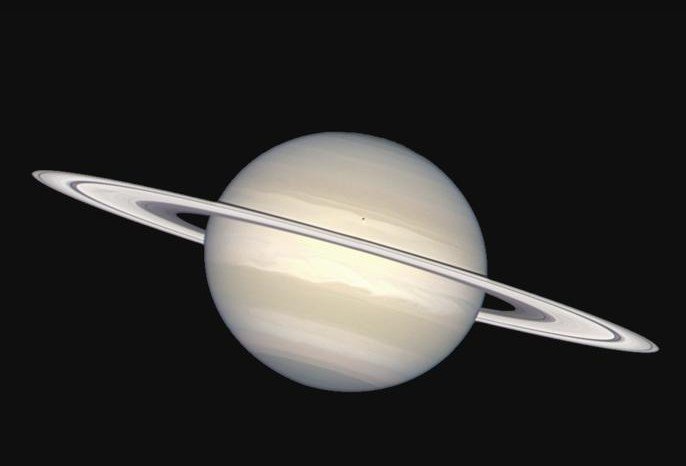
Astronomers used tools like the Hubble Space Telescope in past crossings to capture similar views. These moments reveal details about Saturn’s moons and atmosphere that the bright rings often obscure.
Why This Event Matters to Stargazers
Events like this spark excitement among astronomy fans. They offer a fresh look at Saturn without its usual sparkle, highlighting the planet’s globe and subtle cloud bands.
For scientists, ring plane crossings provide chances to study hidden features. In history, these alignments led to discoveries of several moons, including Titan and Enceladus. Saturn now boasts 146 known moons, the most in our solar system.
This 2025 double event is unusual. Normally, crossings happen every 13 to 15 years, but orbital quirks brought two close together this time.
The illusion entertains casual viewers too. Social media buzzed with photos and reactions, as people shared telescope views of the “naked” planet.
Key Facts About Saturn’s Rings
Saturn’s rings fascinate people for good reasons. They consist mainly of ice particles, dust, and rocks, ranging from tiny grains to house-sized chunks.
Here are some standout details:
- The rings formed about 100 million years ago, possibly from a shattered moon or comet debris.
- They reflect sunlight brightly, making Saturn shine as a golden point in the night sky.
- NASA’s Cassini mission revealed the rings are slowly raining material onto the planet, which could make them vanish in 100 to 300 million years.
Experts predict the rings will fully fade over vast timescales, but for now, they remain a solar system highlight.
| Feature | Description | Interesting Note |
|---|---|---|
| Width | Up to 170,000 miles | Larger than the distance from Earth to the Moon |
| Thickness | 10 to 30 meters in most areas | Thinner than a football field |
| Composition | Mostly water ice | Gives them a shiny, reflective quality |
| Number of Rings | Seven main rings | Labeled A through G, with gaps in between |
| Discovery | Observed by Galileo in 1610 | He thought they were moons at first |
When Will the Rings Return?
Do not worry, the rings will reappear soon. After the November 23 crossing, they will gradually tilt back into view over the coming months.
By early 2026, telescopes will show them widening again. The full display peaks around 2032, when Saturn’s tilt offers the broadest angle.
For now, Saturn rises in the east after sunset and sets before dawn. It shines at magnitude 1.1 in the constellation Aquarius, visible to the naked eye as a steady light.
Track apps or star charts can help locate it. The next ring plane crossing won’t happen until around 2038 or 2039.
How to View Saturn Safely
Anyone with a small telescope can enjoy this event. Look for Saturn in the evening sky, away from city lights for the best view.
Binoculars might show the planet as a dot, but a telescope reveals the thin ring line during the crossing. Join local astronomy clubs for group viewings or online streams.
Remember, never look directly at the sun when scanning nearby areas. Safe observing keeps the fun going.
This cosmic show reminds us of the wonders above. It connects everyday people to the vast universe.
Share your thoughts or photos in the comments below. Did you catch the view? Spread the word to friends who love space news.